How Edward Jenner decided to test cowpox against smallpox
In 1796 a country doctor gave an eight-year-old boy cowpox, then deliberately exposed him to smallpox. The five choices behind the first vaccine, what they risked, and what the record does and does not say.
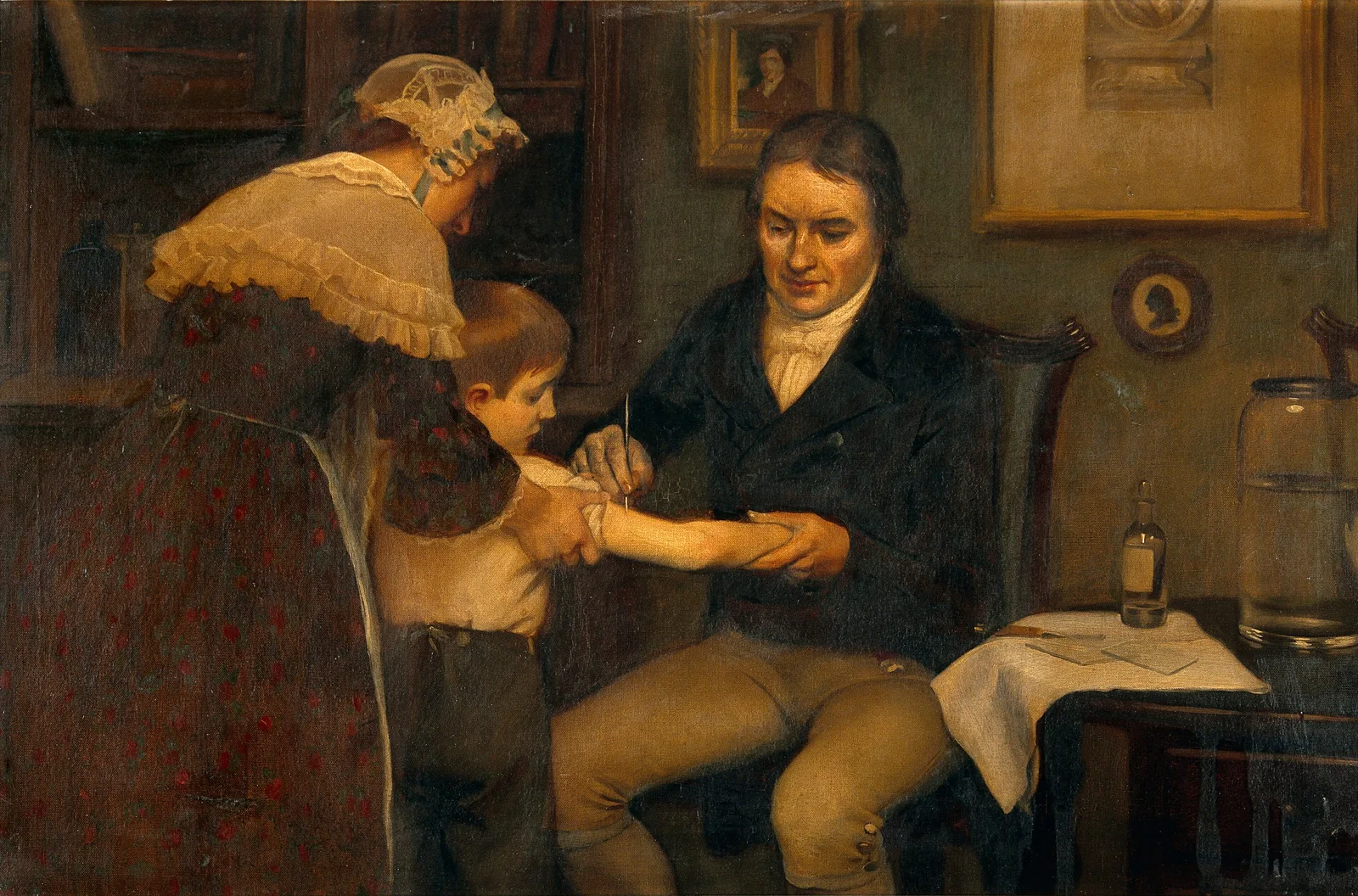
1796 · Berkeley, Gloucestershire. Edward Jenner gave a healthy eight-year-old boy cowpox on purpose, then tested whether it had made him safe from smallpox.
The situation
Smallpox was one of the most feared diseases in 18th-century Britain. It killed many of those it infected and scarred and blinded others, and children were especially at risk.
There was one defence. Variolation, brought to Britain by Lady Mary Wortley Montagu in 1721, meant scratching material from a smallpox sore into the skin of a healthy person. Most people got a milder case and were protected afterwards. But it was real smallpox: some died of it, and a variolated person could spread the disease to others. Jenner had been variolated himself as a boy, and the experience affected his health for years.
In the countryside there was another idea. Farm workers said that people who had caught cowpox, a mild disease picked up from cows' udders, did not catch smallpox. By 1768 a surgeon, John Fewster, had come to believe it. In 1774 a Dorset farmer, Benjamin Jesty, gave cowpox to his wife and two sons during an epidemic. Between 1770 and 1791 several others in England and Germany tried cowpox against smallpox.
Edward Jenner was a country doctor and surgeon in Berkeley, Gloucestershire, born there in 1749. He had trained in London under the surgeon John Hunter and been elected a Fellow of the Royal Society in 1788 for a study of the cuckoo that combined watching birds, experiment and dissection. He was used to testing a belief rather than repeating it.
The choices
1796 · Turn a farmyard belief into a test
What the believers had were stories: people who had had cowpox and later seemed to escape smallpox. Stories could be argued away. Perhaps those people had had a mild smallpox nobody noticed, or had simply been lucky.
He had three roads. He could keep collecting such stories, which was safe and would never settle the question. He could leave the idea to the farmers who already acted on it in their own families. Or he could give cowpox to someone who had never had smallpox or cowpox, deliberately, and watch what happened.
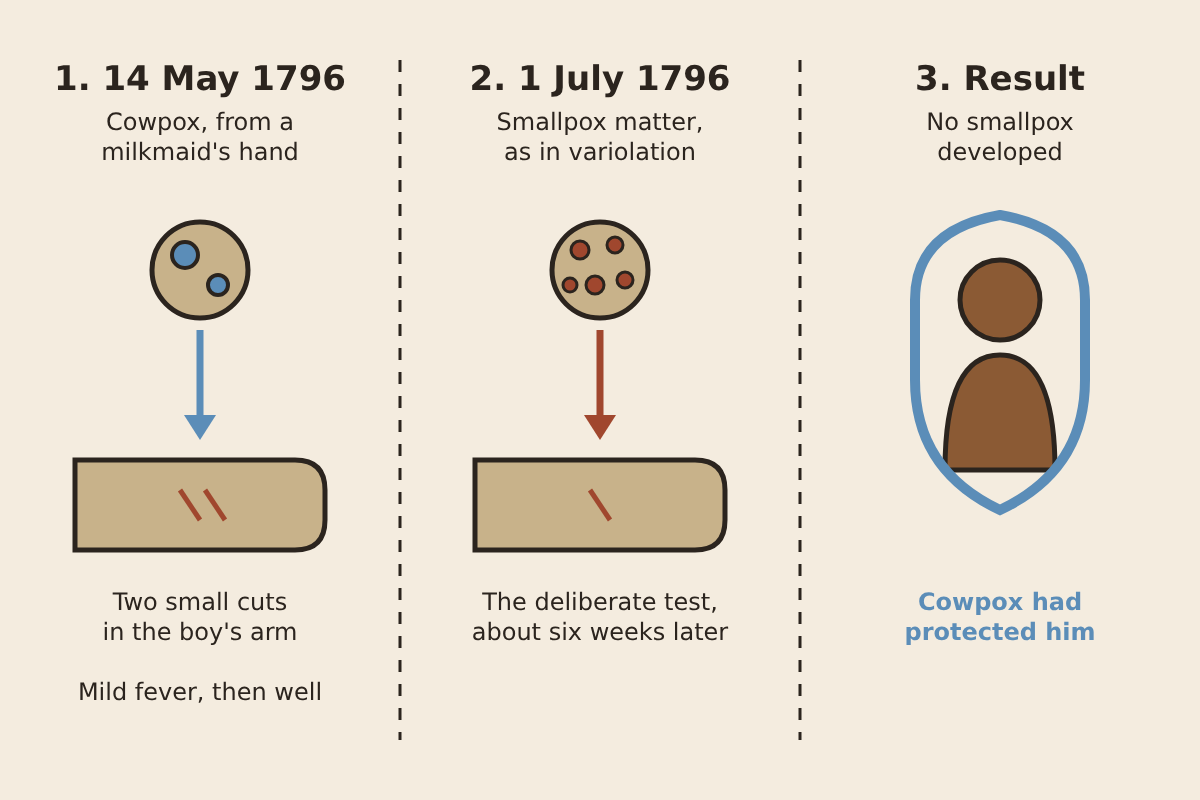
In May 1796 a milkmaid, Sarah Nelmes, caught cowpox from a cow called Blossom and had fresh sores on her hand. On 14 May Jenner took fluid from those sores and put it into two small cuts in the arm of James Phipps, about eight years old, the son of a labourer who worked as Jenner's gardener. The boy had a fever and some discomfort for a few days, then recovered.
- Keep collecting stories. No risk to anyone, and no proof.
- Leave it to the farmers. Some families would be protected; medicine would learn nothing.
- Give cowpox on purpose. A controlled case he could watch from start to end.
It is a choice no doctor could make today. A child of a poor family, chosen by his father's employer, could not give the consent we now require. The record does not tell us what the Phipps family were told.
1 July 1796 · Test the boy with smallpox
A mild illness proved nothing on its own. The question was whether the boy was now safe from smallpox.
Here the fork was sharp. Jenner could have assumed the cowpox had worked and stopped. That left the boy's protection untested and Jenner with no evidence. He could have waited for Phipps to meet smallpox naturally, which might take years and might kill him if the theory was wrong. Or he could do what was already standard practice and variolate him. In our reading this last path asked the boy to face no greater danger than the many children variolated in those years, and it gave Jenner a clean answer quickly.
- Assume it worked. Kind to the boy for now, but proves nothing.
- Wait for a natural outbreak. Years of waiting, and a real risk of death.
- Variolate him. The usual practice of the day, turned into a test.
On 1 July 1796 Jenner inoculated Phipps with matter from a smallpox sore. No disease followed. Phipps was later exposed to smallpox in the same way many more times, more than twenty by some accounts, and never caught it.
1797 · Keep going after the Royal Society said no
Jenner wrote up his work for the Royal Society, the body that had elected him for the cuckoo. The paper was not published. One case, however striking, did not convince.
He could have let it drop. He was a country doctor with a practice to run. He could also have printed the single case elsewhere and hoped for the best. He chose to collect more evidence first, 23 cases in all by the time he published. Among them was his own son Robert, 11 months old.
- Let it drop. The Society's silence would have ended most country doctors' interest.
- Print the single case. Fast, and just as easy to dismiss.
- Build more cases. Slower, and it put his own family into the experiment.
1798 · Publish the whole case, with a name
In 1798 Jenner published An Inquiry into the Causes and Effects of the Variolæ Vaccinæ, a short book setting out his cases. Variolae vaccinae means "smallpox of the cow"; from vacca, cow, came the word vaccine.
He could have published only the cases that went cleanly, or presented a cautious note for doctors to try. Instead he put out his cases with his reasoning, including a theory that turned out to be wrong: he thought cowpox came from a disease of horses' heels called "the grease". Some of his conclusions were right and some were wrong, but because he had set them down plainly, others could test and correct them.
- Write a cautious note. Less exposed to attack, and easy to ignore.
- Publish the whole case. Every case and theory in the open, the mistaken ones too.
After 1798 · Give up his ordinary practice for vaccination
The book started an argument. The medical establishment debated it at length. In 1802 the caricaturist James Gillray drew Jenner's patients sprouting little cows from their bodies.
Jenner could have returned to his practice in Berkeley and let others take the idea forward. Instead he spent the rest of his working life promoting vaccination, and that work took over from his ordinary medical practice. Parliament voted him £10,000 in 1802 and another £20,000 five years later.
- Return to his practice. A comfortable life, with the idea in other hands.
- Promote vaccination. Years of controversy, at the cost of his regular work.
What it changed
Vaccination spread fast. Napoleon had French troops vaccinated, and Spain's Balmis Expedition of 1803 to 1806 carried the vaccine to the Americas, the Philippines, Macao and China. In 1840 Britain banned variolation and offered free cowpox vaccination. In 1980, after a worldwide campaign that relied on vaccination, the World Health Organization declared smallpox eradicated.
Jenner's word outlived his method. When the Viennese doctor Ferdinand von Hebra announced in 1847 that Ignaz Semmelweis had found how to stop childbed fever, he compared its importance to Jenner's cowpox. Medicine in those decades was learning to settle questions by testing and counting, as John Snow did with cholera in London.
James Phipps lived until 1853. Jenner later gave him, his wife and their two children a free lease on a cottage in Berkeley, and Phipps attended Jenner's funeral in 1823.
The road not taken
The biggest fork was 1797, when the Royal Society did not publish his paper. Jesty and others had already protected people with cowpox without making the case to medicine, and their work stayed local. Had Jenner stopped there, the likeliest outcome is that cowpox would have stayed a country belief for some years more, while variolation, with its own deaths and its risk of spreading smallpox, remained the only defence. Someone else would probably have made the test eventually, since the idea was widely known among farmers and some doctors. But his cases in print are what let other doctors repeat the work quickly.
Legend and record
The story goes that Jenner got his idea from the clear skin of milkmaids, who never had smallpox scars. That tale comes from his biographer John Baron, who speculated about it, and historians now treat it as a myth. Cowpox protection was already a widely known country belief, and others had tested it before him.
The painting often used to show the first vaccination, including the one at the top of this page, is by Ernest Board, made in the early 20th century, long after the event. It imagines the scene; it is not a record of it. Blossom's hide hangs in the library of St George's medical school in London, and her horns are at Jenner's house in Berkeley.
Sources
- Edward Jenner, An Inquiry into the Causes and Effects of the Variolæ Vaccinæ (1798), digitised copy, Internet Archive
- John Baron, The Life of Edward Jenner, vol. 2 (1838), HathiTrust
- Arthur Boylston, "The origins of vaccination: myths and reality", Journal of the Royal Society of Medicine 106(9), 2013
- Jonathan Jarry, "The white lie at the heart of vaccine history", McGill Office for Science and Society, 2023
- Derrick Baxby, "Jenner, Edward (1749–1823)", Oxford Dictionary of National Biography (doi:10.1093/ref:odnb/14749)
- Edward Jenner, overview, Wikipedia
- James Phipps, overview, Wikipedia
