How Florey, Chain and Heatley chose to turn penicillin into a medicine
Fleming found penicillin in 1928 and could not concentrate it. Ten years later an Oxford team chose to try: an assay first, a mould factory of bottles and bedpans, eight mice with controls, and a dying policeman.
25 May 1940 · Oxford. Howard Florey's team gave four of eight infected mice penicillin and left four untreated, to find out whether Alexander Fleming's forgotten mould juice could cure an infection inside a living body.
The situation
By the late 1930s doctors had their first drugs that could stop a bacterial infection inside the body. Gerhard Domagk introduced the sulphonamides in Germany in 1935, and by 1936 Leonard Colebrook at Queen Charlotte's Hospital in London had used sulphanilamide on 38 almost hopeless cases of puerperal fever with only three deaths. That was the same childbed fever that Ignaz Semmelweis had fought with handwashing ninety years earlier. The next 26 cases were treated without a single death.
So the idea of a chemical that kills microbes without killing the patient was established. The new drugs were synthetic, made in chemical factories. Substances made by moulds and bacteria were a curiosity of the laboratory.
One of them had a name. In 1928, at St Mary's Hospital in London, Alexander Fleming noticed that colonies of staphylococci dissolved on a culture plate that had been contaminated by a mould, Penicillium notatum. He published the next year and called the substance penicillin. But he and his colleagues could not concentrate it, and the work stalled. Penicillin was a known effect with no drug attached.
The choices
1938 · Pick the forgotten mould out of the literature
Howard Florey was Professor of Pathology at Oxford. In 1938 he and Ernst Boris Chain, a young German-Jewish refugee biochemist, set out to study the natural antibacterial substances that scientists had reported over the years and try to extract them.
The obvious road was the one the field was already on: chase better sulphonamides, which were working in hospitals. Another was to spread the effort across many of the reported substances. Chain reviewed the reports, and penicillin looked the most promising. They chose to start there, with a substance its own discoverer had not managed to purify.
- Follow the sulphonamides. Proven drugs, crowded field.
- Survey many natural substances. Broad, slow, likely to stay shallow.
- Bet on penicillin first. The most promising report, and a known purification problem.
The record does not show that anyone at the time expected a wonder drug. Chain's review made penicillin the first candidate, not a certainty.
c. 1939 · Build a way to measure before trying to purify
Norman Heatley, a biochemist who had joined Florey's department after his Cambridge PhD in 1936, took on the problem. Fleming's group had not managed to concentrate penicillin. Without a reliable way to tell how much penicillin a sample held, every purification step was guesswork: you could not know whether a step had concentrated the drug or destroyed it.
The team could have pushed straight on with chemistry and hoped. Heatley instead devised an assay, a test of culture samples that showed whether they held more or less penicillin. Every later step, from growing the mould to extracting the drug, could now be scored.
- Purify blind. Faster to start, impossible to steer.
- Measure first. A delay now, and a yardstick for every step after.
1939–1940 · Grow the mould in anything that holds liquid
Penicillin came out of the mould in tiny amounts. The historian Howard Markel writes that it took 2,000 litres of mould culture fluid to get enough pure penicillin to treat a single person with sepsis. Britain was at war.
The team could have waited for industrial equipment and backing that did not exist. Heatley built a makeshift mould factory in the laboratory instead. He used every available container, bottle and bedpan to grow the mould, then drew off the fluid and developed ways to purify the drug from it. Accounts of his work credit him with the method of moving penicillin out of the broth into a solvent and then back into water by changing its acidity.
- Wait for proper equipment. Clean and scalable, and not coming in wartime.
- Improvise in the lab. Small, laborious, available now.
25 May 1940 · Test it in mice, with controls
By late May there was enough penicillin for a critical experiment. Germany had just invaded the Netherlands and Belgium, and the Dunkirk evacuation was days away.
There were three ways forward. The team could keep testing penicillin on bacteria in dishes, which proved nothing about a living body. They could try it on a patient, with no idea of a safe dose or whether it worked at all. Or they could infect animals and compare treated with untreated.
They infected eight mice with a lethal dose of streptococci. Four received penicillin under the skin; four controls did not. All the controls died, and the treated mice survived. Two days later they ran it again with ten mice: all six treated animals survived, and three of the four controls died.
- Keep to the dish. Safe and inconclusive.
- Go straight to a patient. Fast, and blind to dose and harm.
- Infect mice and keep controls. The untreated mice make the result impossible to explain away.
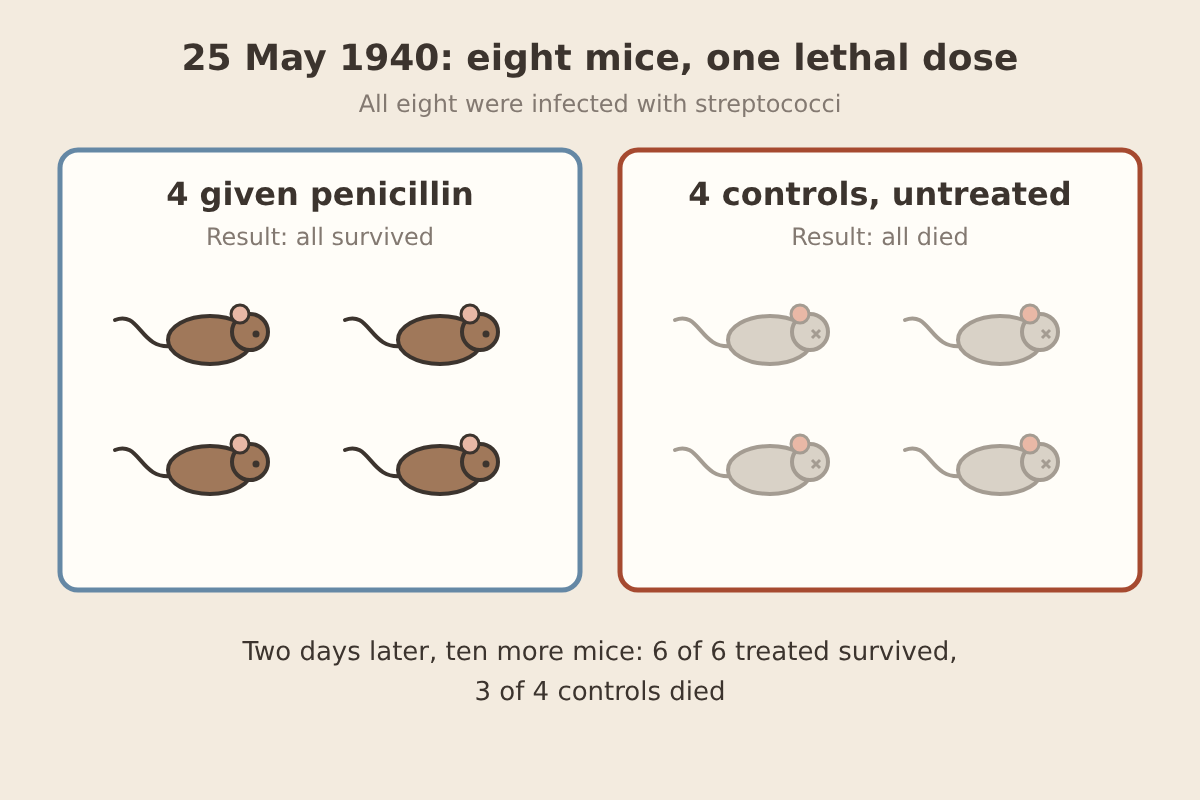
The controls are what made the result count. A single recovered mouse could have been lucky; four dead controls beside four live treated mice could not. It is a step beyond Edward Jenner's test on one boy in 1796, which had no comparison at all.
Early 1941 · Treat a dying man with too little drug
By the beginning of 1941 Florey had enough penicillin to try it on people, though nowhere near enough to be sure of finishing a course. The first patient was a 43-year-old policeman dying of a staphylococcal and streptococcal blood infection, with abscesses in his lungs and an infected bone in his arm.
The team could have waited until they had stockpiled enough to guarantee a full course. That would have meant more weeks of growing mould while he, and patients like him, died of infections the sulphonamides had not cured. They chose to start with a man who would otherwise die.
Within a day of penicillin by intravenous drip his condition had improved. After five days he was much better. Then the supply ran out, and he died a month later. The total dose had been 220,000 units, which Harold Ellis, writing in 2016, called a small single injection by modern standards.
- Wait for a full supply. Safer for the trial, deadly for the patients in front of them.
- Treat the dying now. Learn what penicillin does in people, at the risk of running out.
They kept going. The next patients included a 15-year-old boy with a streptococcal infection of the hip that sulphonamides had failed to clear, who recovered quickly, and a 14-year-old boy with a staphylococcal bone infection of the thigh, cured after two weeks. On 16 August 1941 The Lancet published the results as "Further observations on penicillin", by Abraham, Chain, Fletcher, Florey, Gardner, Heatley and Jennings.
Summer 1941 · Take the mould to America
The Oxford results showed that penicillin worked, and that a laboratory full of bottles and bedpans could never make enough of it.
In the summer of 1941 Florey and Heatley flew to the United States and worked with American scientists in Peoria, Illinois, on ways to mass-produce the drug. Florey went home; Heatley stayed on into 1942. In Peoria a laboratory assistant, Mary Hunt, brought in a mouldy cantaloupe from the market, and its mould turned out to produce far more penicillin than Fleming's strain.
- Keep production in Britain. Control of the work, and too little capacity.
- Share it with American laboratories. Scale, at the cost of handing the method over.
What it changed
The small series of Oxford patients showed that a fatal staphylococcal blood infection could be cured, and that penicillin, unlike the sulphonamides, worked in the presence of pus. That was enough to start large-scale production. By the Allied landings in Sicily in 1943 there was enough to treat infected war wounds. Florey was knighted in 1944, and in 1945 Florey, Fleming and Chain shared the Nobel Prize in Physiology or Medicine. Heatley, whose assay and improvised factory made the 1940 experiment possible, was not among them.
The road not taken
The biggest fork was the first: picking penicillin out of the literature at all. Had Florey and Chain followed the field into sulphonamides, Fleming's observation might have stayed a curiosity for years more. Others would probably have come back to it eventually, because the effect was published and real. But the Oxford team's controlled mouse test and early patients are what turned a laboratory effect into a reason to build factories, and without them that case would have had to wait for someone else to make it.
Legend and record
Popular accounts of the mouse experiment vary. One widely read version describes 50 infected mice over the summer of 1940; Ellis's account, followed here, describes eight mice on 25 May and ten more two days later. Accounts also differ on when the first patient fell ill and was treated: one places the case in September 1940, while Ellis puts the treatment at the beginning of 1941. The same version gives the policeman's age as 48; Ellis gives 43. The outcome is the same in every version: he improved, the drug ran out, and he died.
