How Florence Nightingale chose numbers over fame to save soldiers' lives
Florence Nightingale could have married well, forced her nurses on hostile doctors, or cashed in her fame. At each fork she took a harder road, and her statistics made the army change.
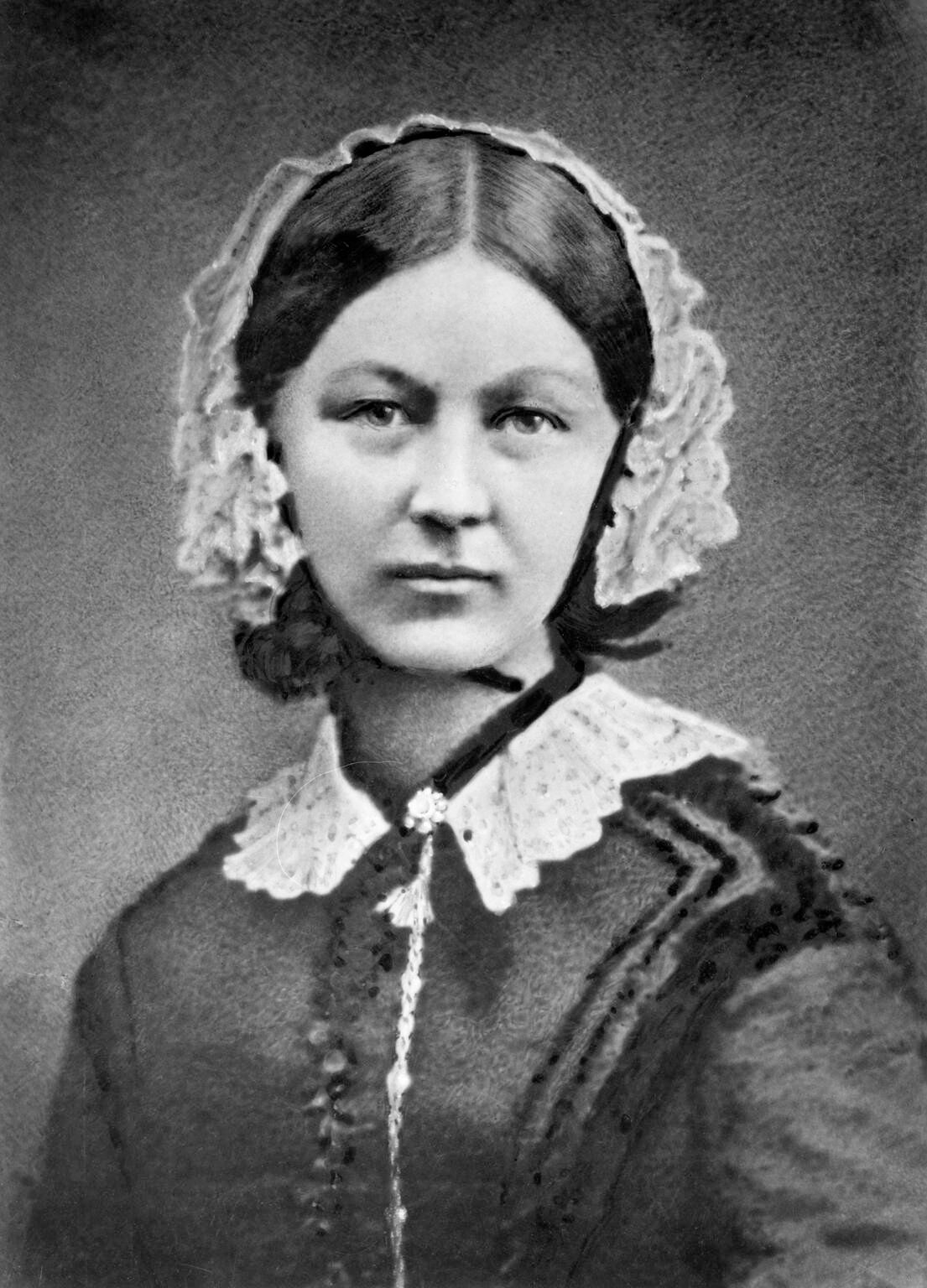
1858 · London. Florence Nightingale chose to fight for soldiers' lives with statistics, and drew a chart showing that most of the British army's dead in the Crimean War had died of disease that could have been prevented.
The situation
By February 1855, about four in ten of the sick and wounded in the British army's hospital at Scutari, across the Bosphorus from Constantinople, were dying. Cholera and typhus ran through the wards. An injured soldier was seven times more likely to die of disease in hospital than on the battlefield.
Out of about 94,000 men sent to the war, by one count 1,760 died of wounds and 16,300 of disease. The woman sent to deal with this had no medical rank, and a family who had spent years trying to stop her.
The choices
1850 · Turn down a brilliant marriage
Richard Monckton Milnes, a poet and politician, had courted Florence Nightingale for years. She was drawn to him, and her parents wanted the match. In 1845 they had refused to let her nurse at Salisbury Infirmary: hospital nurses of the day had a reputation for drink.
Marrying Milnes offered a clever husband who understood her, and peace at home at last. It also meant, in her words, a life spent making society and arranging domestic things. A middle road ran between: stay single, do charity on the family estates and keep the peace, with her calling left unanswered. The hardest road was to refuse him and hold out for work among the sick, with no door yet open.
- Marry Milnes. A clever husband and her parents' blessing, and a life of society and domestic things.
- Stay single and do charity at home. Peace with her family, and her calling left unanswered.
- Refuse him and hold out for nursing. Her family's dismay, and no door to nursing yet open.
She refused. Marriage to him, she wrote, would satisfy her mind and heart but not her active nature. On her 30th birthday in 1850 she wrote in her diary: no more love, no more marriage. It cost her: her biographer E. T. Cook judged her affection for him as strong as half the marriages in the world rest on. In 1851 she spent three months at Kaiserswerth in Germany, and in 1853 ran a small hospital for gentlewomen in Harley Street, unpaid.
1854 · At Scutari, wait for the doctors to ask
In October 1854 the Secretary at War, Sidney Herbert, asked her to take nurses to Scutari at government expense. He promised her the fullest co-operation of the medical staff. She arrived on 4 November with 38 nurses, on the eve of the battle of Inkerman. The doctors and officials met her with sullen opposition. In one ward junior surgeons were told to keep away from her.
With Herbert's backing and the ear of London, she could have marched her nurses into every ward. The men would have had help sooner, but the doctors would likely have become enemies able to wreck the venture. Or she could have reported the hostility home and left, probably ending the experiment of women nursing in a war hospital. The third way looked like weakness: let each surgeon decide.
- Force the nurses into every ward. Faster help for the men, and doctors likely turned into enemies.
- Report the hostility and go home. An end to the fight, and probably to the experiment.
- Let each surgeon decide. The doctors' trust in time, and men left without nurses meanwhile.
She chose to wait. One of her nurses recalled the order: attend only to patients of surgeons who wished for their services, and never act without the doctor's leave. She saw Scutari as the chance to prove women could nurse in wartime, which needed discipline and the doctors' trust. Meanwhile she ran cleaning, linen, kitchens and stores, paid for with money raised by The Times. Men in the wards of hostile surgeons went without her nurses until the Inkerman wounded poured in and the swamped doctors accepted them.
1856 · Come home quietly and work from the inside
She returned in August 1856 a national heroine. Triumphal arches were proposed, and regimental bands wanted to meet her train. She was emaciated after nearly dying of Crimean fever, and certain the army's medical system had to be rebuilt.
Her fame was a weapon. The question was how to fire it. A hero's welcome would have rallied the country, at the risk of turning a reformer into a celebrity. Her body argued for rest at home; no one is recorded urging it. She herself weighed the loudest road, an appeal to the whole country like Cobden's over the Corn Laws. It promised pressure no minister could ignore, and risked shutting the War Office door.
- Take the hero's welcome. A rallied country, and the risk of becoming a celebrity, not a reformer.
- Rest at home. Time to recover, and the reform left to others.
- Appeal to the whole country. Pressure no minister could ignore, and a War Office door shut.
- Lobby from within, publication in reserve. Access to ministers, and a slow, draining fight.
She travelled home as "Miss Smith", dodged the reception and worked from the inside, the public weapon kept loaded. She saw the Queen at Balmoral in September 1856 and Lord Panmure in November. Nothing happened. She wrote to Herbert that in three months she would publish her experience of the Crimean campaign unless there was a fair and tangible pledge of reform. In 1857 a Royal Commission on the health of the army was set up, with Herbert as chairman. The cost fell on her body: in 1857 she collapsed, and began about twenty years as an invalid.
1858 · Put the dead in a picture and send it to the powerful
With the statistician William Farr she had the figures. Now busy men had to look.
The safe course was tables. The Royal Commission's report carried many, and officials would probably file them unread. The bold course was to put her own 830-page report on sale. It would have got ahead of the official report and risked offending the ministers she needed.
- Leave the figures in tables. The respected form, and probably filed unread.
- Put her full report on sale. A public stir, and ministers she needed offended.
- Print privately and send pictures to the powerful. Her case on the right desks, and no public credit.
She took a third line. Her report was printed and privately circulated, and her diagrams went into an anonymous pamphlet: 2,000 copies for the Queen, ministers, both Houses, and army officers at home, in India and the colonies.
Her "coxcombs" showed each month of the war as a wedge: blue for preventable disease, red for wounds, black for other causes. The blue dwarfed the red. Farr praised how clearly they explained themselves. Framed copies went to the War Office. She called it "our flank march upon the enemy". The cost was credit: the pamphlet bore no name. That year she became the first woman elected a Fellow of the Statistical Society of London.
1860 · Hand the school to a hospital she could not run
The public had given more than £40,000 to a Nightingale Fund to train nurses. Her first idea had been to run the institution herself. Her doctors now gave her months to live.
Waiting until she was well enough would keep the school under her own eye, and leave public money lying idle, possibly for good. She tried the opposite first: in March 1858 she asked the Fund's council to spend it as they saw fit. The council refused and asked her to wait. That left a compromise. St Thomas's Hospital, whose matron Mrs Wardroper she admired, offered rooms for a school bearing her name, on a smaller plan than she wanted.
- Wait until she could run it herself. Her own school, and public money idle, possibly for good.
- Give the Fund to its council. Freedom from the burden, and her ideas left out.
- Work through St Thomas's. A school at last, on a smaller plan than she wanted.
She took it, calling the plan not the best possible but the best conceivable. In June 1860 the first fifteen probationers began a year's training. The cost was control: within a year six had been dismissed or left, and later she complained that her probationers did half the hospital's work.
What it changed
The Royal Commission brought an Army Medical School in 1860 and reforms to barracks and military hospitals. Major London hospitals took up her model statistics forms. Nurses trained at St Thomas's went on to run hospitals elsewhere. She did most of this from bed, and died in 1910, aged 90.
The road not taken
The biggest fork came in 1856, when Nightingale had more public goodwill than any minister. Spent in the press, it would likely have drawn cheers. But an army can stall a public campaign for years, and a War Office she had shamed might have kept from her the numbers that later made her case.
She spent her fame slowly, in private, and it bought a Royal Commission and the army's own figures. Without them the rose diagram would probably never have been drawn.
Legend and record
The popular story has her nursing cutting the death rate at Scutari from over 40 percent to 2 percent. In fact deaths were at their worst in her first winter. A Sanitary Commission began cleaning the hospitals on 17 March 1855, and within three weeks mortality fell by half. She came to accept that bad sanitation had killed most of the men. She also later denied she had been trained at Kaiserswerth: the nursing there, she said, was nil.
Sources
- Nightingale, Florence, by Monica E. Baly and H. C. G. Matthew (Oxford Dictionary of National Biography, reproduced by MacTutor)
- The Life of Florence Nightingale, vol. 1, by Sir Edward Cook (1913), Project Gutenberg
- Nightingale, statistics and the Crimean War, by Lynn McDonald (Collected Works of Florence Nightingale, University of Guelph)
- Florence Nightingale: the Lady with the Lamp (National Army Museum)
- Florence Nightingale (MacTutor History of Mathematics, University of St Andrews)
- Nightingale 2020: the bicentenary of our first female fellow (Royal Statistical Society)
- Florence Nightingale and the Crimean War (The Victorian Web)
