How Katherine Johnson chose the lab, the briefings and John Glenn's orbit
Teaching or NACA, the computing pool or the briefing room, a co-author's credit or none. The forks that put Katherine Johnson's hand-checked numbers under John Glenn's flight.
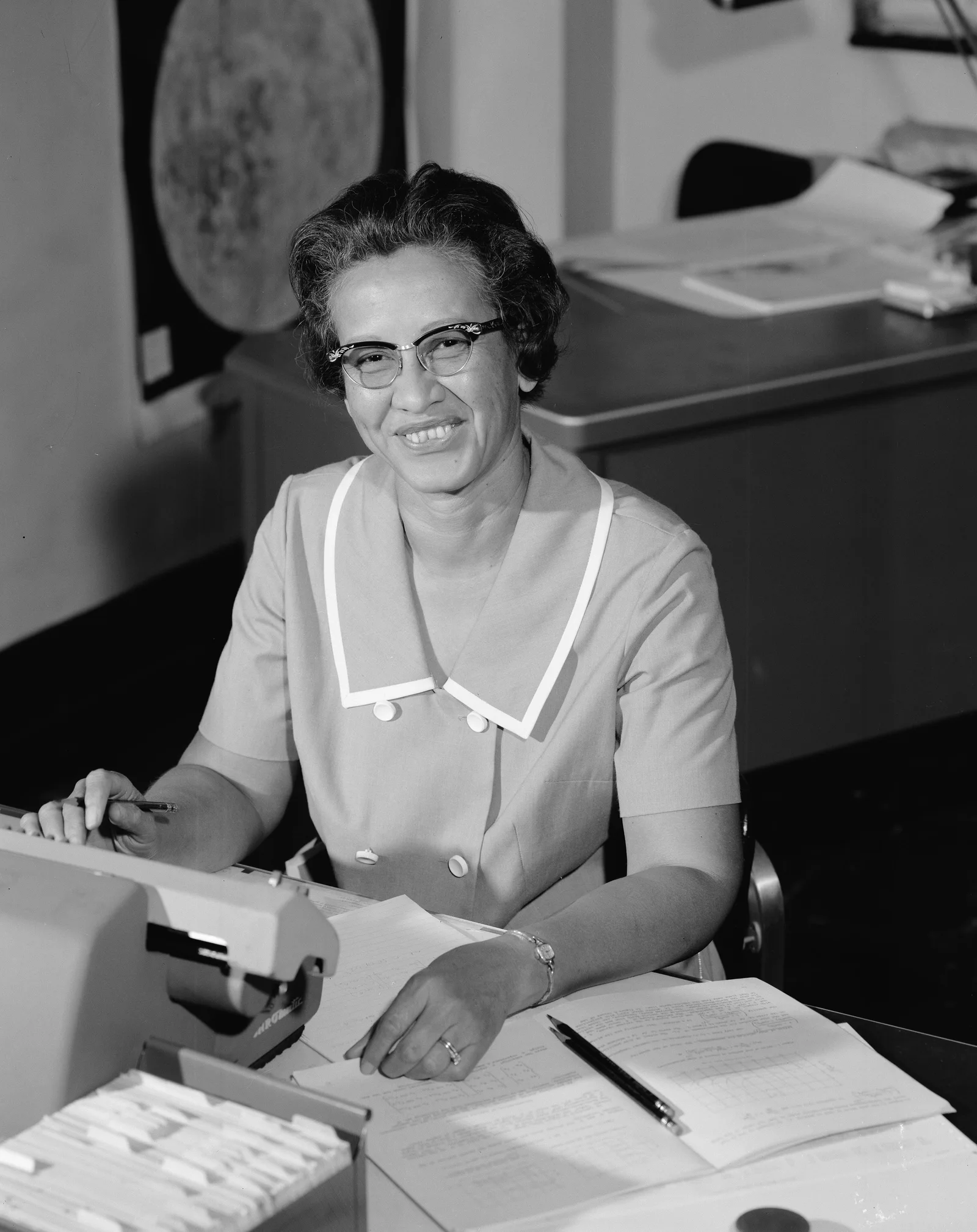
1962 · Langley, Virginia. Before he would fly into orbit, John Glenn asked for the computer's numbers to be checked by hand by one mathematician: Katherine Johnson.
The situation
An astronaut was about to ride an Atlas missile into orbit. If his numbers were wrong, the capsule could fire its retrorockets at the wrong moment and come down in the wrong place.
John Glenn's numbers for Friendship 7 came from IBM 7090 computers at NASA's Goddard Space Flight Center. Glenn, the Smithsonian notes, was not comfortable with his fate depending on a machine. For years trajectories had been worked out by people, many of them women, themselves called computers.
He wanted one of them to check. He asked the engineers to "get the girl". She was Katherine Johnson, a Black mathematician from West Virginia who had joined Langley's segregated West Area Computing unit in 1953. Several forks could have kept her out of that room.
The choices
1939 · Take a seat at West Virginia University, then step away
Johnson was born in 1918 in White Sulphur Springs, West Virginia, and was in high school years ahead of her age group, at 10 by one NASA account and 13 by another. At West Virginia State College the mathematician W. W. Schieffelin Claytor, one of the first African Americans to earn a doctorate in mathematics, built courses for her and steered her towards research. She graduated in 1937, aged 18, in mathematics and French, and went to teach in a Black public school in Virginia. In 1939, after a Supreme Court ruling, West Virginia quietly began to integrate its graduate schools. Her college president, John W. Davis, picked her and two men to be the first Black students offered places at West Virginia University.
Here the road split three ways. The classroom was steady work, one of the few jobs open to a Black woman with a degree, and staying in it risked nothing, though it led nowhere near the research Claytor had prepared her for. The offer pointed the other way: a graduate degree, the usual entry to research, at the price of being one of three Black students, and the only woman, in a university that did not want them. A degree also meant putting off a family.
- Stay in the classroom. Steady work and no risk, but nowhere near research.
- Take the place and finish the degree. The road into research, in a hostile place, family put off.
- Take the place, then leave to start a family. Integrate the university, then give up the degree.
She left her teaching job and enrolled. Then, after the first session, she left to start a family with her first husband, James Goble. That is NASA's account; her daughter later told the Charleston Gazette-Mail that her mother said the place "was not a friendly environment". The cost was the degree. She went back to teaching once her three daughters were older.
1953 · Take the NACA contract, not the teaching one
At a family gathering in the early 1950s a relative mentioned that the National Advisory Committee for Aeronautics, NASA's predecessor, was hiring Black women as mathematicians at its Langley laboratory in Hampton, Virginia. In 1952 her husband had fallen ill and she was teaching again. She applied at once. That year's places were already filled.
The next year she applied again, and this time two offers lay in front of her: a teaching contract and a NACA contract. One was work she knew, the safer income for a family with a sick husband and three children. The other was a post in a segregated computing pool, on a temporary footing, in a new town, doing sums for engineers she had never met.
- Sign the teaching contract. Work she knew, and safer with a sick husband.
- Take the NACA job. Temporary, segregated and in a new town, but real mathematics.
She took NACA, remembering Claytor's advice to prepare for research. The family moved to Newport News, and she started at Langley in the summer of 1953. Two weeks in, Dorothy Vaughan sent her to the Flight Research Division, and the post became permanent. The risk was real: in December 1956 her husband died of cancer, and she was raising three girls on the job she had chosen.
1950s · Ask to be in the briefings
In Flight Research the engineers were men, and the women computers did the sums they were handed. As Johnson told NASA, "The women did what they were told to do." Women were not allowed into the briefings where engineers discussed what the numbers were for.
The easy path was the one everyone around her took: do the work, ask nothing, and stay a calculator for other people's ideas. It was safe. Pushing against the custom was not. A Black woman in a segregated workplace who kept knocking on a closed door risked being marked as trouble, and there was a middle way, slower and second-hand, of finding out afterwards what had been said.
- Do the sums and ask nothing. Safe, but a calculator for other people's ideas.
- Ask questions from outside. Slower, and second-hand.
- Ask to be let in. Push against the custom and risk being marked as trouble.
She tried the middle way first. She asked what had gone on in each briefing and kept asking, then asked whether there was a law against women attending. There was none. By her account the engineers "just got tired of answering all my questions" and let her in. "I asked questions; I wanted to know why," she told NASA. No cost is recorded, only the gain: she learned what the trajectories were for, and became the only woman of her time pulled out of the computing pool to work on other programmes.
1960 · Finish the report and put her name on it
Johnson had been working with the engineer Ted Skopinski on the equations for an orbital flight that would bring a spacecraft down over a chosen spot on Earth. Skopinski wanted to leave for Houston. By her account, their supervisor Henry Pearson, whom she called "not a fan of women", kept pushing him to finish the report first.
So the report could go out one of two ways. Skopinski could finish it alone, the usual outcome in a division where no woman had yet been credited as an author of a research report, and her work would vanish under his name. Or she could take over a report a sceptical supervisor wanted from someone else, and stand behind the mathematics in print.
- Let Skopinski finish it alone. The usual outcome, with her work under his name.
- Finish it and sign it. Take over the report and stand behind the mathematics in print.
It was Skopinski who tipped it. By her account he told Pearson that Katherine should finish the report, as she had done most of the work. She finished it, and in 1960 "Determination of Azimuth Angle at Burnout for Placing a Satellite Over a Selected Earth Position" came out under both names, the first time a woman in the division was credited as an author. She went on to do the trajectory analysis for Alan Shepard's flight in May 1961, the first American in space.
1962 · Run the whole orbit again, by hand
Glenn's launch kept slipping from December 1961 to February 1962. Somewhere in that stretch the request came down: check the IBM's orbit. As Johnson recalled to Margot Lee Shetterly, Glenn said that if she said the numbers were good, he was ready to go.
How far should a check go? In our reading, a spot-check was open to her: test a handful of key figures, such as the retrofire time and the splashdown point, and sign off. That would have been quicker, but it would not have tested the whole orbit. The thorough path was days at a desk calculating machine, working the flight from start to finish.
- Spot-check the key figures. Quicker, but the whole orbit would go untested.
- Run the whole flight again, by hand. Days of work, with an astronaut's life on it.
She ran the same numbers through the same equations programmed into the computer, by hand on her mechanical calculator. Shetterly writes that it took a day and a half; the Smithsonian says a couple of weeks. Her figures matched the computer's. The cost was days of work, and being the last check. On 20 February 1962 Glenn flew three orbits and came home.
What it changed
Glenn became the first American to orbit the Earth. Johnson went on to work on calculations for Apollo, including Apollo 11, and the Space Shuttle, and wrote or co-wrote 26 research reports before retiring in 1986, after 33 years.
Outside NASA she was little known for decades. In 2015, aged 97, she received the Presidential Medal of Freedom. The 2016 book and film Hidden Figures made her famous. NASA named a building at Langley after her. She died in 2020, aged 101.
The road not taken
The biggest fork was 1953: a classroom or a lab. With a sick husband and three daughters, teaching was the sensible choice, and she had taken that road before. Had she signed it, she would probably have stayed a teacher, and NACA would likely have filled the post with someone else. What would probably have been lost was her habit of asking why, getting into the briefings and signing the report, which is how an astronaut came to know whose numbers he trusted. Glenn would likely still have flown, but the first woman's name on a Flight Research report would have waited.
Legend and record
In the film Hidden Figures, Glenn phones Langley from the launch pad for a last-minute check. The Smithsonian says that call was invented. The real date is unsettled: the Smithsonian says autumn 1961, while Shetterly placed it close to the launch. The time it took is disputed too: a day and a half (Shetterly), three days (the film's director), a couple of weeks (the Smithsonian).
Sources
- Katherine Johnson biography (NASA)
- Katherine Johnson: a lifetime of STEM (NASA)
- West Virginian of the Year: Katherine G. Johnson (Charleston Gazette-Mail, 2015)
- Johnson, Katherine Coleman Goble (Contemporary Black Biography, via Encyclopedia.com)
- Determination of Azimuth Angle at Burnout for Placing a Satellite Over a Selected Earth Position, Skopinski and Johnson, 1960 (NASA Technical Reports Server)
- John Glenn, Katherine Johnson and Hidden Figures (National Air and Space Museum)
- Hidden Figures: John Glenn mystery (collectSPACE)
- NASA Langley's Katherine Johnson Computational Research Facility officially opens (NASA)
