How Marie and Pierre Curie chose to measure their way to radium
Marie Curie picked the rays everyone else ignored, measured them instead of photographing them, and trusted an odd reading in pitchblende. The choices that followed, with Pierre Curie, led to the discovery of polonium and radium in 1898.
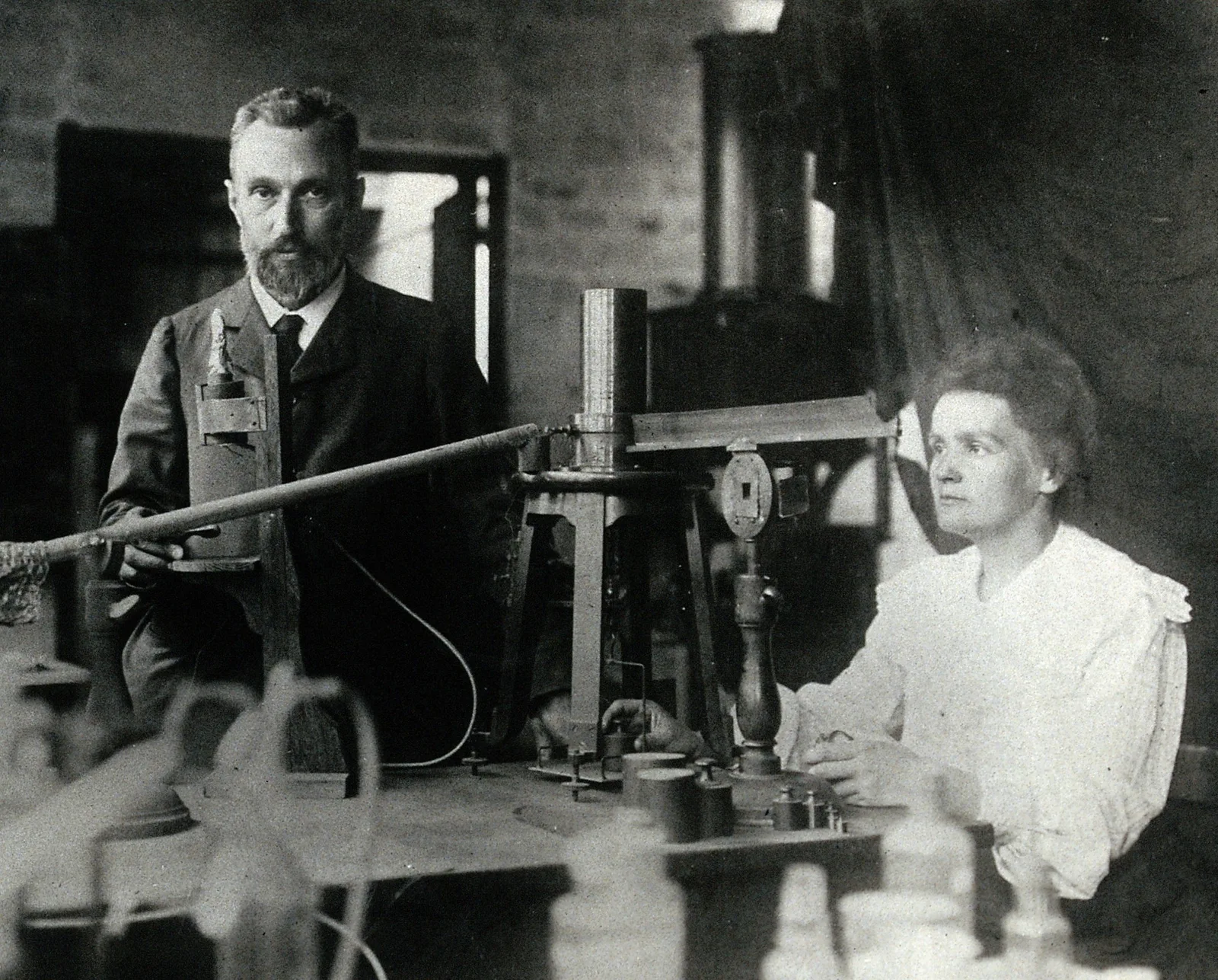
1898 · Paris. Marie Curie decided that the extra radioactivity in pitchblende came from an unknown element, and set out with Pierre Curie to separate it by chemistry and follow it with an electrometer.
The situation
In December 1895 the German physicist Wilhelm Röntgen found rays that passed through wood and flesh and could photograph the bones of a living hand. He called them X-rays, X for unknown, and the scientific world rushed after them. A few months later, in early 1896, the French physicist Henri Becquerel reported something quieter: uranium compounds kept in the dark gave off rays that fogged a photographic plate. Becquerel's rays were much weaker than X-rays, and most researchers left them alone.
Behind both discoveries sat an assumption almost nobody questioned. The atom, from the Greek for "uncuttable", was taken to be the smallest piece of matter, indivisible and unchanging. Nobody suspected the energy stored inside it.
Marie Skłodowska had come to Paris from Warsaw in 1891 to study at the Sorbonne. By 1895, when she married the physicist Pierre Curie, she held two degrees, in physics and in mathematics. Their daughter Irène was born in September 1897. That autumn Marie needed a subject for a doctorate.
The choices
1897 · Pick the rays everyone else had dropped
The obvious subject was X-rays. They were the sensation of the decade, and a thesis on them would have sat at the centre of physics. It would also have meant reading a fast-growing pile of papers by people who had a head start.
Becquerel's uranium rays were the opposite: neglected, barely written about, and with no crowd to compete against. As the American Institute of Physics account of her work puts it, that is what appealed to her. With almost no literature to master, she could begin experiments at once.
The director of the Municipal School of Industrial Physics and Chemistry, where Pierre taught, let her use a cramped, damp storeroom as a laboratory.
- Join the X-ray rush. The fashionable subject, and a crowded one.
- Take the neglected uranium rays. Little to read, nobody to race, and no promise anything was there.
1897 · Measure the rays instead of photographing them
Becquerel had studied his rays with photographic plates. A plate shows that something darkened it; comparing one sample with another that way is slow and hard to put a number on.
Marie had another tool in the family. About fifteen years earlier Pierre and his older brother Jacques had invented a new electrometer, an instrument that measures extremely small electric currents. Uranium rays make the air around them conduct electricity. Put a uranium compound on one metal plate, set a second plate opposite, keep a voltage between them, and a tiny current flows. The size of that current is a measure of how active the sample is.
"Instead of making these bodies act upon photographic plates," she wrote, "I preferred to determine the intensity of their radiation by measuring the conductivity of the air exposed to the action of the rays." The damp storeroom air leaked charge away, which made the readings harder, but she managed to make them reproducible.
With numbers she could compare. She found that the activity stayed the same whether the uranium was solid or powdered, pure or in a compound, wet or dry, lit or heated. It depended only on how much uranium was there. From that she drew her central hypothesis: the rays were a property of the uranium atom itself, not of how the atoms were combined.
- Use photographic plates, as Becquerel did. Proven, and hard to compare sample with sample.
- Measure the current with the Curie electrometer. Fiddly in damp air, and it gives a number for every sample.
1898 · Trust the odd reading, and test it with a home-made mineral
She went looking for other elements that behaved like uranium. She tested all the known elements, helped by chemists who gave her mineral samples, some of them rare. In April 1898 she found that thorium compounds also gave off the rays. She coined a word for the behaviour: radioactivity.
Then the minerals did something they were not supposed to do. Every radioactive mineral she measured contained uranium or thorium, but some were more active than their uranium content could explain. Certain samples of pitchblende, 75 per cent uranium oxide, were about four times as radioactive as the oxide itself. Chalcolite, a crystallised phosphate of copper and uranium, was about twice as radioactive as uranium. The accepted view was that no mineral should be more radioactive than metallic uranium. She faced the choice the Wright brothers faced when their gliders fell short of the published lift tables: trust the measurement or the textbook.
She had several ways to read that. The damp room and a delicate instrument made measurement error a fair suspicion, and she could have set the minerals aside. She could have reported the excess as a curiosity and gone on mapping uranium and thorium compounds, which was already a solid thesis.
Instead she made chalcolite herself, from pure chemicals. Her synthetic crystals had exactly the activity their uranium content predicted, about half that of uranium. The excess was real, and it lived only in the natural mineral. It is the logic of the untreated mice in the Oxford penicillin test of 1940: a comparison that rules out the easy explanation. "I then thought," she told the Nobel audience in 1911, "that the greater activity of the natural minerals might be determined by the presence of a small quantity of a highly-radioactive material, different from uranium, thorium and the elements known at present."
- Treat it as error. Safe, given the conditions, and it throws away the clue.
- Report it as a curiosity. Honest, and it leaves the question for someone else.
- Make the mineral from pure chemicals and compare. A control experiment that settles whether the excess is real.
1898 · Hunt with chemistry, steer with the electrometer
Pierre found the problem interesting enough to put aside his own research on crystals and join her. They expected the unknown substance might make up several per cent of the ore. It turned out to be a tiny fraction of that, in a mineral built from as many as 30 elements.
Ordinary chemical analysis would not find it, since there was too little to see. Spectroscopy, which identifies elements by the colours of light they give off, needed a sample rich enough to show a new line. So the Curies joined chemistry to measurement. They split the pitchblende into parts with standard methods (dissolve this in acid, pour it off, precipitate that), then measured every part with the electrometer and kept following the most active one. Each separation became a question: where did the activity go?
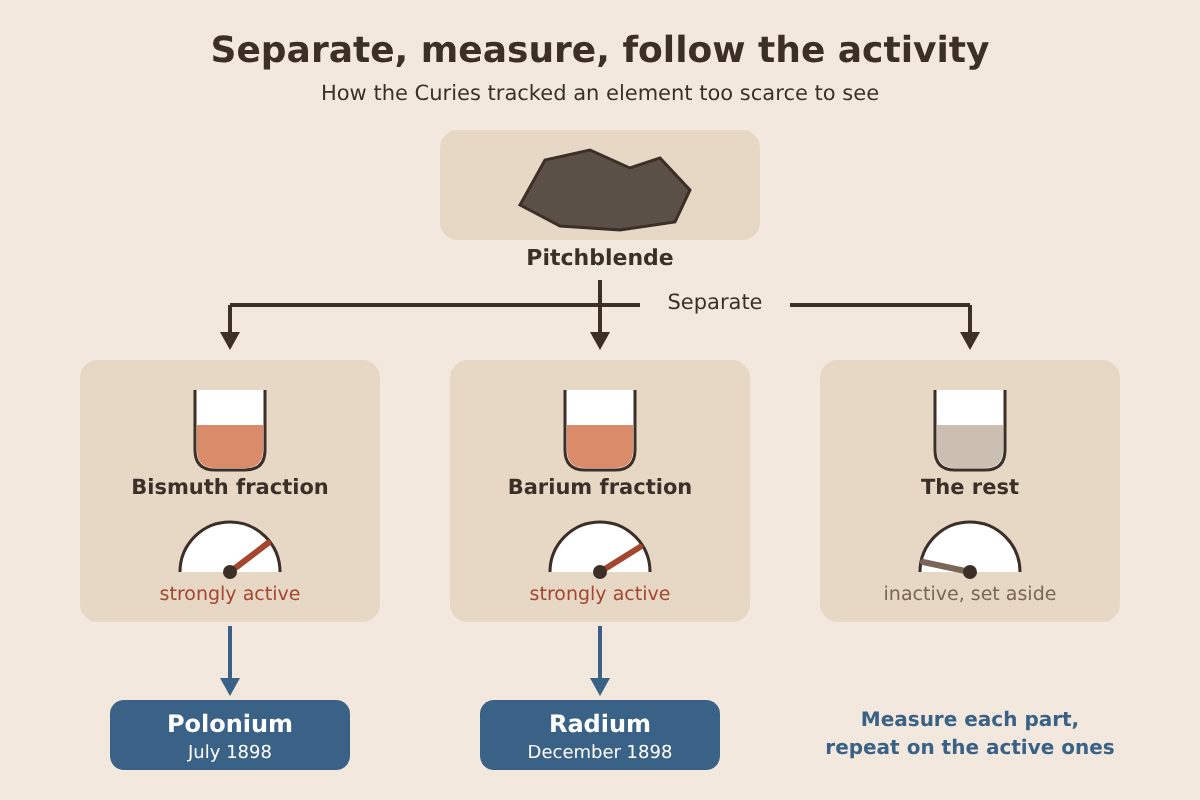
The activity collected in two places. One fraction was mostly bismuth, the other mostly barium, and neither bismuth nor barium is ordinarily radioactive. In July 1898 they announced that the bismuth fraction held a new element, and named it polonium, after Poland, the country of Marie's birth. On 26 December 1898, with their colleague Gustave Bémont, they announced a second, in the barium fraction, and called it radium.
The radium paper shows how thin the evidence still was, and how carefully they argued it. Chemically, their substance looked like nearly pure barium, and its atomic weight differed from barium's by no more than experimental error. But its chloride, purified step by step, went from 60 to 900 times as active as uranium, and they had stopped only because they ran out of material. The spectroscopist Eugène Demarçay found a line that matched no known element, hardly visible in the weaker sample and prominent in the stronger. A line that grew with the activity was, they wrote, "a very serious reason" to attribute it to the radioactive part.
They could have waited until they held a pure sample before announcing anything. They published on the evidence they had, and named the method along with the elements: radioactivity, treated as a property of atoms, had become a way to search for new ones.
- Rely on ordinary analysis. The standard road, blind to traces this small.
- Wait for a pure sample before announcing. Safer for their reputations, and years away.
- Separate, measure, publish the evidence. A new method, and claims chemists would want proved.
c. 1899 · Isolate radium, by the ton
Chemists did want proof. As Marie put it later, "from the chemical viewpoint, it was as if our substances had been, the one pure bismuth, and the other pure barium." The only way to show they were new elements was to separate them and weigh them.
The best source was pitchblende from St Joachimsthal, now Jáchymov in the Czech Republic, which was mined for uranium salts. What was left after the uranium came out still held the radium and polonium, and the mine treated that residue as waste. The Austrian government gave the Curies a ton of it. In the laboratory they could treat a few kilograms at a time, up to 20, and radium turned out to be present at a few tenths of a gram per ton. That meant thousands of kilograms.
They could have rested their case on the radioactive evidence and moved on to studying the rays. They could have stayed at laboratory scale and worked through the residue twenty kilograms at a time. They took the factory route. The Central Chemical Products Company, which sold Pierre's scientific instruments, ran the first heavy treatment of the ore, and their colleague André Debierne adapted their laboratory methods into industrial processes. In return the company took a share of the radium salts.
The final purification was Marie's, in a former dissecting room across the school courtyard that let in the weather and that she called the "miserable old shed". Radium chloride is a little less soluble than barium chloride, so when a solution crystallises, the radium gathers slightly in the crystals. Repeat that enough times and the barium falls away. "To obtain a very pure salt," she said, "I have had to perform several thousands of crystallizations." The electrometer scored each round.
Over three years of this produced about a tenth of a gram of pure radium chloride. Her measurements of the atomic weight climbed as the sample grew purer, from barium's 138 through 146 and 174 to 225, and finally to 226.45, measured in 1907 with 0.4 grams of very pure salt. Radium had a place of its own in the periodic table, in the column under barium. Polonium never yielded: it decays so quickly, half of it gone in 138 days, that she could not isolate it.
- Rest on the radioactive evidence. Quicker, and chemists stay unconvinced.
- Stay at laboratory scale. Independent, and far too slow at a few tenths of a gram per ton.
- Bring in industry and process tons. A share of the product given away, and enough radium to weigh.
c. 1903 · Publish the method and patent nothing
By now radium was worth a great deal. Pierre had found it could damage living tissue, and doctors began using it against cancer and skin diseases. In 1904 the industrialist Armet de Lisle began working with the Curies on the best ways to treat pitchblende, and his factory would soon sell radium to the medical profession.
The Curies could have patented their extraction process. They had good reasons to want money: a child and a parent to support, an expensive research programme, and, as Marie wrote, "toward 1900, some increase in our income was indispensable." Instead they published every process in detail and patented none. The AIP account gives their reasons: registering and defending patents would have used up money and time they could not spare, they shared the view common among Paris scientists that researchers should spend as little energy as possible on personal finances, and they had no reason to expect radium to make a fortune.
- Patent the process. Income for the lab, and years of paperwork and lawsuits.
- Publish everything. Anyone could make radium, and the Curies would not grow rich.
What it changed
In June 1903 Marie defended her doctoral thesis, Research on Radioactive Substances. That December the Nobel Prize for Physics went half to Becquerel and half to Marie and Pierre Curie. The French Academy of Sciences had nominated only Becquerel and Pierre; Pierre, alerted by the Swedish mathematician Magnus Mittag-Leffler, insisted that Marie be considered with him. In 1911 she received a second Nobel Prize, in chemistry, "by the discovery of the elements radium and polonium, by the isolation of radium and the study of the nature and compounds of this remarkable element".
Her hypothesis that radioactivity belongs to the atom outlasted the old atom itself. Ernest Rutherford and Frederick Soddy built on it to show that radioactive elements change into other elements as they give off radiation, which meant atoms were neither indivisible nor unchanging. Her search method found more elements in other hands: Debierne's actinium, Otto Hahn's radiothorium and mesothorium, Bertram Boltwood's ionium. In 1910 she and Debierne produced radium as a pure metal.
The work had a price no one then understood. Both Curies damaged their fingertips handling radioactive material without protection, and Marie lost nearly 20 pounds during her thesis research. Pierre's health declined, and they did not connect his attacks of pain with the radiation. On 19 April 1906 he was run over by a horse-drawn wagon while crossing a Paris street, and killed. Marie died in 1934.
Others carried parts of the load. Jacques Curie co-invented the electrometer. Bémont co-signed the radium paper and Demarçay read its spectrum. Debierne turned laboratory chemistry into factory chemistry, and the workers of the Central Chemical Products Company did the heavy first treatment of the ore. Pierre's father, a physician who moved in with the family, looked after Irène while Marie worked.
The road not taken
The biggest fork was the odd reading in 1898. A pitchblende sample four times as active as its uranium was easy to blame on a damp room and a sensitive instrument, and the accepted view said it could not be right. Had she filed it as error, her thesis would still have been sound: a careful survey of uranium and thorium compounds.
Someone else would probably have found the new elements within a few years, since pitchblende was mined, studied and sold, and Becquerel's rays were now known. What that person would also have needed is the step she took next. The synthetic chalcolite turned a suspicion into a fact, and the separate-and-measure method turned the fact into a hunt. Without both, the excess activity is a puzzle, not a pointer to two elements.
Legend and record
The popular picture of the Curies, spread by Marie's own 1923 biography of Pierre and by the 1943 film Madame Curie, is of two people working alone and poor in a leaking shed. The shed was real and the work was exhausting. She wrote of spending whole days "mixing a boiling mass with a heavy iron rod nearly as large as myself". But the AIP's historians point out what that telling leaves out: from early on the Curies had help from industry, the first ton of ore was treated in a company's factory, and their grants and salaries were about what good scientists of the day received. Marie's complaint, then and later, was that science as a whole got too little money.
Sources
- Marie Curie, "Radium and the New Concepts in Chemistry", Nobel Lecture, 11 December 1911, NobelPrize.org
- P. Curie, M. Curie and G. Bémont, "On a new, strongly radio-active substance contained in pitchblende", Comptes rendus de l'Académie des Sciences 127 (26 December 1898), pp. 1215–1217, English translation, American Institute of Physics
- American Institute of Physics, "Marie Curie and the Science of Radioactivity": X-rays and Uranium Rays
- American Institute of Physics, "Marie Curie and the Science of Radioactivity": The Discovery of Polonium and Radium
- American Institute of Physics, "Marie Curie and the Science of Radioactivity": Founding the Radium Industry
- American Institute of Physics, "Marie Curie and the Science of Radioactivity": Working Wife and Mother
- American Institute of Physics, "Marie Curie and the Science of Radioactivity": Honors from Abroad
- American Institute of Physics, "Marie Curie and the Science of Radioactivity": The Nobel Prize and Its Aftermath
- American Institute of Physics, "Marie Curie and the Science of Radioactivity": Marie Curie and Her Legend
- American Institute of Physics, "Marie Curie and the Science of Radioactivity": Tragedy and Adjustment
- American Institute of Physics, "Radioactivity: The Unstable Nucleus and its Uses"
- Nobel Foundation, "Marie Curie – Biographical" and "Marie Curie – Facts", NobelPrize.org
