How Joseph Lister decided to fight wound infection with carbolic acid
In the 1860s an open fracture often cost a leg. The story of how Joseph Lister took a chemist's idea about germs into a Glasgow ward, chose carbolic acid, and tested it on compound fractures, failures included.
1865 · Glasgow. Joseph Lister laid a pad soaked in carbolic acid over the open fracture of an 11-year-old boy, to kill the germs before they could reach the wound.
The situation
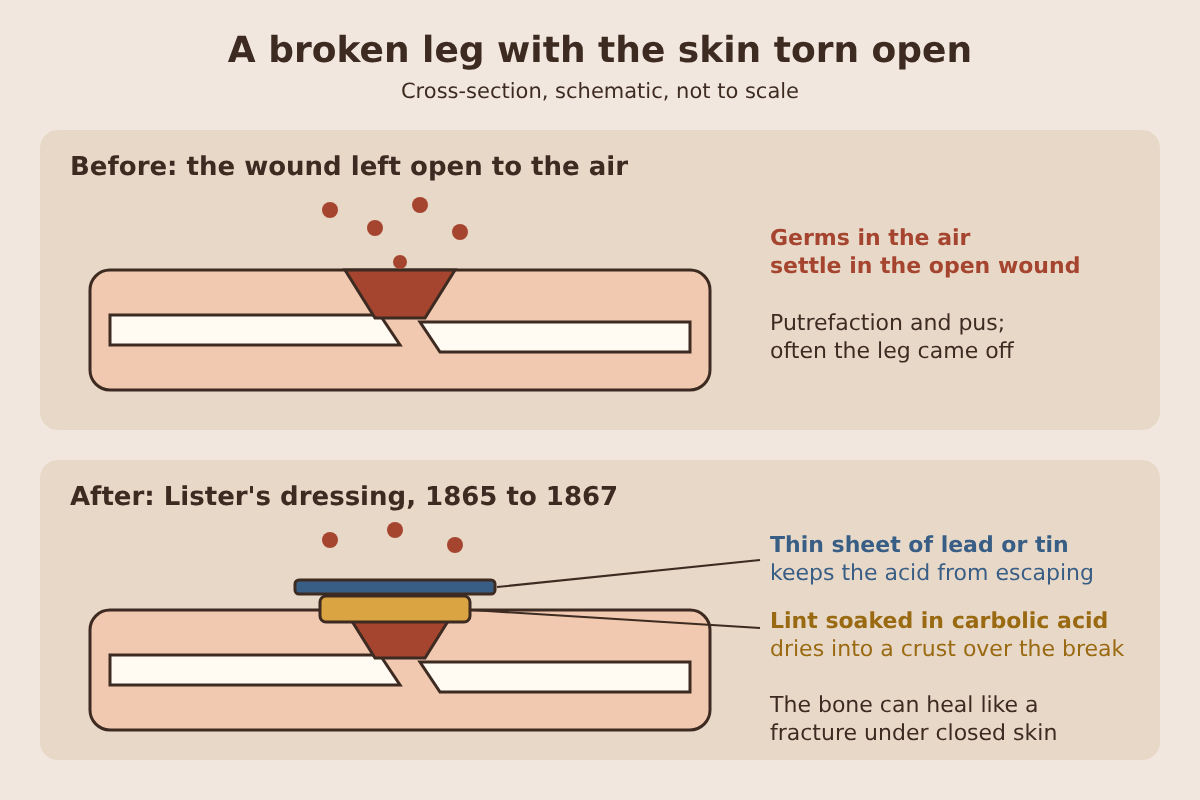
In the 1860s a broken leg could kill you, but only if the bone came through the skin. Surgeons called that a compound fracture. A simple fracture, with the skin intact, usually healed. A compound fracture very often festered: the wound filled with pus, the flesh rotted, and the surgeon's usual answer was to cut the leg off before the infection killed the patient.
Nobody knew why the open wound went bad. Pus was widely treated as a normal stage of healing. Bed linen and surgeons' coats were rarely washed, and instruments were seldom cleaned between patients. The common explanation for hospital infections was bad air, a vague poison rising from crowded wards, which no surgeon could do much about.
Joseph Lister, born in Essex in 1827 and trained in London and Edinburgh, became Regius Professor of Surgery at the University of Glasgow in 1860 and took charge of wards at Glasgow Royal Infirmary the next year. His wife Agnes, the daughter of his Edinburgh teacher James Syme, worked beside him on his experiments for the rest of her life. He was a careful laboratory man, and he wanted to know why his patients' wounds rotted.
The choices
1865 · Take a chemist's tip about Pasteur seriously
The lead came from outside surgery. Thomas Anderson, Glasgow's professor of chemistry, pointed Lister to the work of the French chemist Louis Pasteur. Pasteur had shown that liquids such as milk kept far longer when protected from the air, and argued that fermentation and putrefaction (rotting) were caused by tiny living organisms carried in the air, not by something that arose by itself in the liquid.
Lister could have filed this as a curiosity about spoiled milk. Most surgeons did; Pasteur was a chemist, and his experiments involved flasks, not patients. He could also have kept fighting the "bad air" of the wards with ventilation and cleaning, which reformers were already urging. Instead he made a leap Pasteur had not made: if rotting was caused by living things from the air, then a rotting wound was a wound that living things had got into. Stop them, and the wound should heal like a simple fracture under closed skin.
- Treat it as a chemist's curiosity. No risk, and no change on the wards.
- Fight the bad air. Better ventilation, a cause everyone already accepted.
- Apply germ theory to wounds. Unproven, and it made the open wound itself the battlefield.
1865 · Kill the germs with a chemical
Pasteur had kept germs out of his flasks in three ways: by filtering the air, by heat, and by chemicals. Filtering air was impossible on a hospital ward, and nobody can boil a living leg. That left a chemical.
Lister chose carbolic acid, now usually called phenol, a by-product of coal tar. In the first of his 1867 articles in The Lancet he explained why: in 1864 he had read an account of the town of Carlisle using it on its sewage, where a small amount stopped the smell from the fields irrigated with the waste. A chemical that stopped sewage from rotting might stop a wound from rotting too.
It was not a gentle choice. Carbolic acid burns skin and damages living tissue. A surgeon could have picked something milder and safer and hoped it was strong enough. Lister picked the agent that he had reason to think worked, and accepted that he would have to learn how much the patient could stand.
- A mild wash. Safe for the flesh, but no evidence it would kill anything.
- Carbolic acid. Proven against rot in sewage, and harsh on living tissue.
August 1865 · Test it where the comparison is built in
He now had to choose where to try it. The obvious place was the operating theatre, where every incision was a fresh wound. But operations varied enormously, and a good result on one could be put down to luck or skill.
Compound fractures were different. Surgeons knew exactly what usually happened to them, and they had a built-in comparison: the same broken bone under closed skin. If carbolic acid could make a compound fracture behave like a simple one, the result would be hard to argue with. And for the patient, the alternative was often amputation, so the risk of trying something new was set against a grim certainty.
On 12 August 1865 an 11-year-old boy, James Greenlees, was admitted to Glasgow Royal Infirmary with a compound fracture of the leg. Lister dressed the wound with lint dipped in carbolic acid. When the dressing was changed four days later, there was no sign of infection, and the bone went on to unite as a simple fracture would.
- Try it in operations. Plenty of cases, but every one different.
- Try it on compound fractures. A known bad outcome to beat, and a clean comparison.
1865–1867 · Treat the failures as instructions
Not every case went like the first. In one, a man Lister's report calls Patrick F., the treatment failed, gangrene set in, and the leg had to be amputated.
A failure like that gave Lister two easy exits. He could quietly drop the method, or leave the case out and report only the successes. He did neither. He kept the case in his published series and wrote that, however it looked to others, to himself it was "perfectly conclusive of the efficacy of carbolic acid for the object in view". What the case taught him was practical. The acid could irritate the wound and draw out fluid, so the dressing needed to let that fluid escape. And the acid evaporated through the oiled silk and gutta-percha (a rubbery natural latex) he had used to cover the crust.
So he changed the dressing. He tried thin sheet lead over the crust, then block tin, the kind used to cap jars of anatomical specimens, because it held the acid in and could be moulded to the limb. Over the following years he also weakened the acid, because full-strength carbolic damaged the very tissue it protected.
- Drop the method. One amputation could be read as proof it did not work.
- Hide the failure. A cleaner story, and a dishonest one.
- Keep the case and fix the dressing. Slower, and it put the failure on the record.
1867 · Wait, then publish case by case
By early 1867 Lister had nearly two years of cases. He could have announced the idea after the first few successes, as many surgeons did with new treatments. He chose to wait, and said in print that he had held back to refine and test the method on more patients.
When he did publish, in a series of articles in The Lancet from March 1867, he did not lead with statistics. He gave case histories: each patient, the injury, the dressing, what went wrong, what he changed, and how it ended. The series covered eleven compound fractures; in the summary usually given, nine healed without infection, one ended in amputation, and one patient died of bleeding from the wound. A fifth article in July set out step by step how to open an abscess under an "antiseptic curtain" of rag soaked in carbolic oil. Later that year he took the principle itself to the British Medical Association meeting in Dublin.
The choice of form mattered. A table of eleven cases proves little. Detailed instructions let other surgeons copy exactly what he did, and his wards became the proof: in the 1867 paper he reported that wards which had been among the unhealthiest in the hospital had gone nine months without a case of pyaemia (blood poisoning), hospital gangrene or erysipelas (a spreading skin infection).
- Announce early. First claim on the idea, but thin evidence.
- Publish statistics. Looks scientific, and too few cases to convince.
- Publish detailed cases. Slow to read, and easy for others to repeat.
What it changed
Acceptance was slow and uneven. The Leeds surgeon Thomas Nunneley wrote that his colleagues had tried Lister's methods and given them up. A colleague of his in Leeds, Thomas Pridgin Teale, wrote to Lister that any failures there were down to not following his rules properly. That exchange sums up the next twenty years: the method worked when it was done exactly, and it was demanding to do exactly.
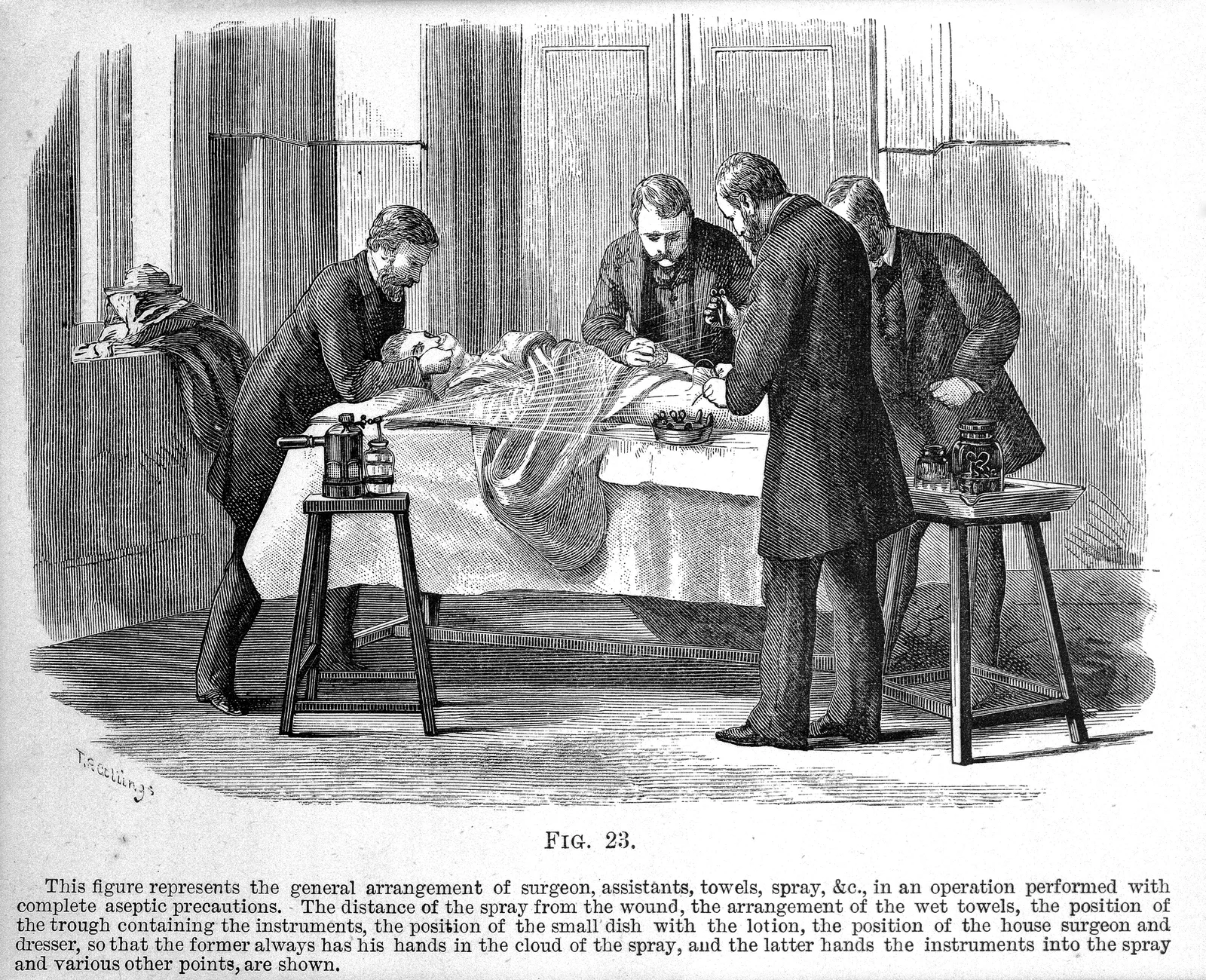
Lister kept adjusting. From 1871 he used a carbolic spray to fill the air around an operation with a fine mist of the acid, first by hand, then on a tripod, then driven by steam. Surgeons in many countries adopted his system. His patients paid a price too; it is likely that many suffered some carbolic acid poisoning.
By the end of the century, surgeons were moving from antisepsis, killing germs on and around the wound, to asepsis, keeping germs away in the first place with sterilised instruments, gowns and gloves. That later practice grew from Lister's principle that wound infection has a cause that can be stopped. The same idea, that an invisible cause can be found and blocked, ran through Ignaz Semmelweis's chlorine handwashing in Vienna two decades earlier and the Oxford team that turned penicillin into a drug seventy years later.
Lister died on 10 February 1912, aged 84.
The road not taken
The biggest fork was the first one: whether a surgeon should take a chemist's experiments on spoiling liquids as a guide to wounds. Had Lister followed the common view and kept fighting "bad air" with ventilation and cleaner wards, his results would probably have improved somewhat, since cleanliness helps whatever the theory. But he would have had no reason to treat the wound itself, and no clean test like the compound fracture to show it. Germ theory was coming anyway; Robert Koch and others would tie specific germs to specific diseases within two decades. The likeliest result is that antiseptic surgery would still have arrived, but later and from someone else, and that thousands more compound fractures in the meantime would have ended in amputation.
Legend and record
Lister is often pictured working inside a cloud of carbolic spray, and the spray became the symbol of his method. The record puts it in its place: the spray came in 1871, years after the dressings that made his name, and he gave it up in the late 1880s. The 1865 to 1867 breakthrough was a soaked dressing and a metal cover.
He is also often called the man who proved germ theory at the bedside. His own writing was more careful. In 1875 he wrote that even someone who doubted that the septic material was alive would have to use the same antiseptic methods, because the practice worked either way. The historian Thomas Schlich has argued that his antiseptic practices were not built on specific laboratory tests, even though Lister presented laboratory work alongside his clinical cases.
Sources
- Joseph Lister, "On the Antiseptic Principle in the Practice of Surgery", British Medical Journal 2 (1867), 246–248, PubMed Central
- Joseph Lister, "On a New Method of Treating Compound Fracture, Abscess, &c., with Observations on the Conditions of Suppuration", The Lancet i (1867), 336–339 and the following issues, and ii (1867), 95–96
- Michael Worboys, "Joseph Lister and the performance of antiseptic surgery", Notes and Records of the Royal Society 67 (2013), 199–209
- Spyros N. Michaleas and others, "Joseph Lister (1827–1912): A Pioneer of Antiseptic Surgery", Cureus 14(12), 2022
- William Watson Cheyne, Antiseptic Surgery: Its Principles, Practice, History and Results (Smith, Elder & Co., London, 1882), source of the engraving of the spray in use
