How Ignaz Semmelweis decided to make doctors wash their hands
In the 1840s one Vienna maternity clinic lost about 10 mothers in 100, the other under 4. The story of how Ignaz Semmelweis found the difference, and the six choices that took him from the autopsy room to a bowl of chlorine.
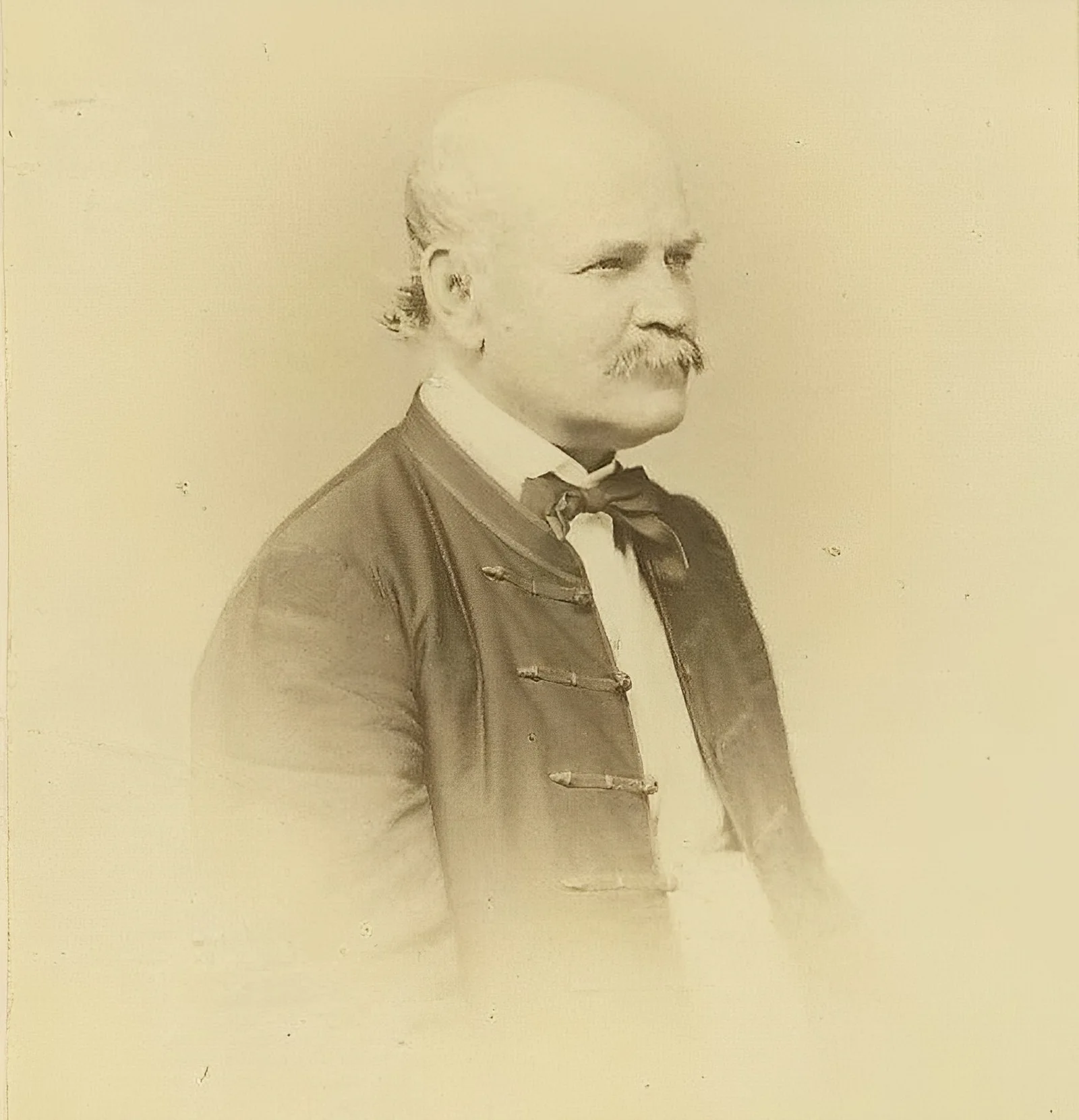
1847 · Vienna. Ignaz Semmelweis ordered every doctor and student to scrub their hands in chlorinated lime before touching a woman in labour.
The situation
In the 1840s the maternity service of the Vienna General Hospital was split into two clinics. The First Clinic trained medical students. The Second Clinic trained midwives.
They did not die at the same rate. Between 1841 and 1846 the First Clinic recorded 1,989 deaths in 20,042 births, close to 10 in every 100 mothers. The Second Clinic recorded 691 deaths in 17,791 births, under 4 in 100. Most of the dead were killed by puerperal fever, also called childbed fever: a fast infection after childbirth, with fever, pain and often death within days.
| Year | First Clinic deaths per 100 births | Second Clinic deaths per 100 births |
|---|---|---|
| 1841 | 7.8 | 3.5 |
| 1842 | 15.8 | 7.6 |
| 1843 | 9.0 | 6.0 |
| 1844 | 8.2 | 2.3 |
| 1845 | 6.9 | 2.0 |
| 1846 | 11.4 | 2.8 |
Nobody had a good explanation. Doctors blamed "epidemic influences", bad air or conditions in the atmosphere, things no one in a hospital could change. Germs had not been discovered; Louis Pasteur's work on them was more than a decade away.
On 1 July 1846 a 28-year-old Hungarian doctor, Ignaz Semmelweis, became assistant to Professor Johann Klein in the First Clinic. It was the worse clinic, and he was the one who had to look the mothers in the eye.
The choices
1846 · Treat the two clinics as an experiment
The gap between the clinics was well known in Vienna. Semmelweis's predecessors had seen the same figures. The accepted view made the gap something to endure: if the cause was in the air, it could not be fixed from inside one ward.
He had two easier roads. He could accept the explanation everyone used and do his job, or he could blame the women's poverty and condition, which many doctors did. Instead he treated the two clinics as a natural comparison. Same hospital, same city, the same kinds of women. Whatever killed mothers in one clinic and not the other had to be something that differed between them.
One fact troubled him most. Women who gave birth in the street on the way to the hospital, and then came in, rarely caught the fever. If the danger lay in the city's air, a street birth should have been at least as risky. Something inside the First Clinic was doing the harm.
- Accept "epidemic influences". The view of most of his profession, and a cause no one could act on.
- Blame the patients. Easy to say, but the same kinds of women went to both clinics.
- Compare the clinics. Hunt for the one difference that matched the deaths.
1846–1847 · Test the obvious causes, and drop them
So he started testing differences. Overcrowding was the obvious suspect, but the Second Clinic was usually the more crowded one, so he set it aside. Climate could not differ between two clinics in the same building complex. He changed the position in which mothers in the First Clinic gave birth. He also considered whether a priest carrying the last rites through the wards frightened women into illness.
None of these closed the gap. This is the unglamorous part of the story, and it was a choice too. A doctor under pressure could have adopted one plausible change, declared it the answer and moved on. Semmelweis kept the figures as his judge, and the figures kept saying no.
- Adopt a plausible fix. Quick to announce, and impossible to check against the deaths.
- Test each difference. Slow, and likely to end in a list of failures.
1847 · Read a friend's death as evidence
In 1847 Semmelweis's friend Jakob Kolletschka was cut by a student's scalpel during a post-mortem examination. He fell ill and died. His own autopsy showed the same kind of damage Semmelweis saw in the mothers who died of childbed fever.
Here the paths split sharply. Kolletschka's death could be filed as a sad accident, one man and one wound, nothing to do with women in labour. Or the likeness could mean that the two diseases were one. If something from a corpse on a blade could kill a healthy man, something from a corpse on a hand might reach a mother.
That second reading pointed straight at the difference he had been looking for. Doctors and medical students did autopsies and then examined women in the First Clinic. Midwives in the Second Clinic did not do autopsies. He called what they carried "cadaverous particles".
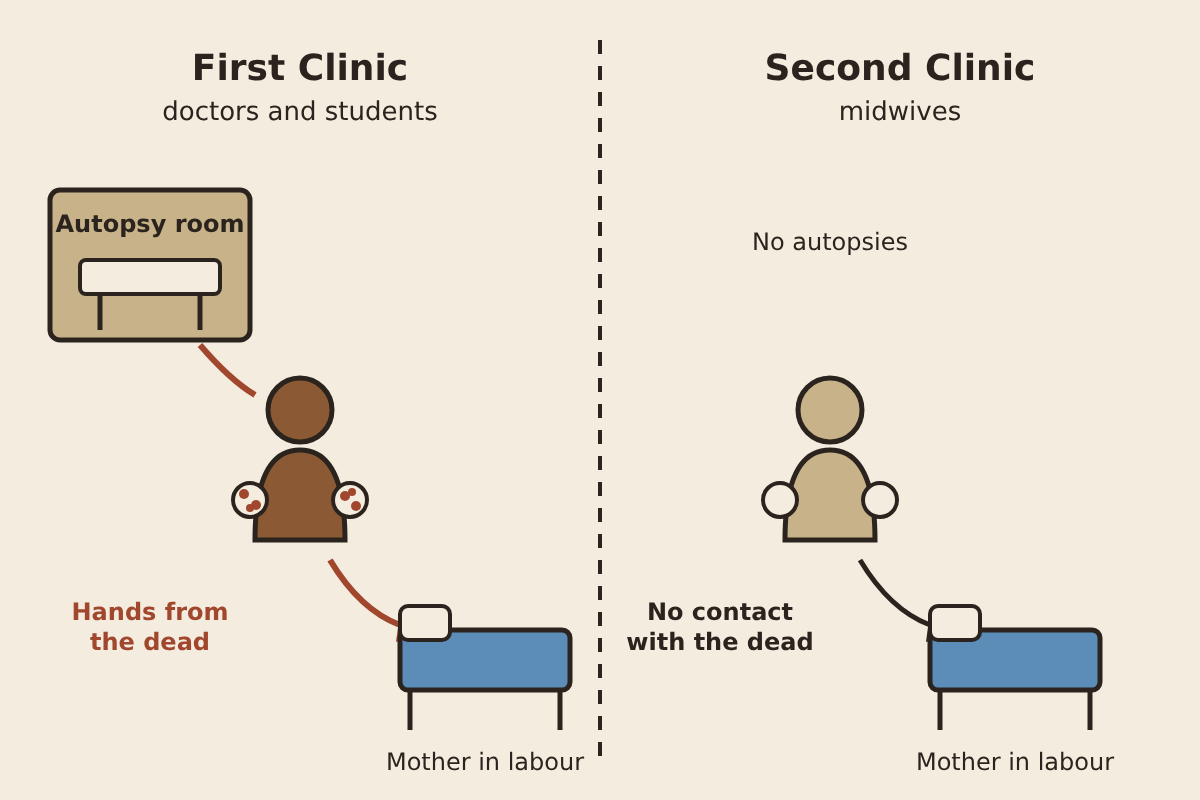
It was an uncomfortable conclusion for a doctor to reach, because it meant the doctors were the danger.
- File it as an accident. No threat to anyone's reputation, and no lead.
- Link the two deaths. It pointed at his own colleagues, his teachers and himself.
May 1847 · Order the washing, not just suggest it
Semmelweis needed something that would take the corpse off the hands, and the best test he had was the smell. He chose chlorinated lime (calcium hypochlorite, close to modern bleach), because it worked best at removing the putrid smell of infected autopsy tissue.
He could have recommended washing and left it to each doctor's judgement. That would have cost him no friends, and in a teaching hospital full of busy students it would very likely have been ignored. He made it a rule instead: from mid-May 1847, everyone coming to examine a woman in the First Clinic washed in the chlorine solution first.
- Recommend washing. Polite, and easy to skip on a busy ward.
- Make it compulsory. Enforce the rule on doctors and students, whatever they thought of it.
The result was quick. In April 1847 the First Clinic's death rate had been 18.3 per 100. In June it was 2.2, in July 1.2, in August 1.9. Over the next year the clinic's death rate fell by about 90 per cent, and for the first time it ran level with the midwives' clinic. In 1848 he widened the rule to every instrument that touched a woman in labour.
1847–1849 · Let others carry the news
He now had a striking result and the figures to back it. The usual road for a discovery was a paper in a medical journal, with the numbers and the reasoning laid out for critics to test. Semmelweis did not take it in these years. He published nothing on the discovery at this stage.
The news travelled through colleagues instead. Ferdinand von Hebra, editor of a leading Viennese medical journal, announced the work in December 1847 and April 1848, and compared its importance to Edward Jenner's cowpox vaccination. But second-hand reports blurred the idea. Some readers took it as one more theory of contagion between patients, which Semmelweis had not claimed.
- Publish a full paper. Puts the evidence in his own words before the profession.
- Leave it to colleagues. Saves time and friction, but others tell the story for him.
The cost came in 1849. His post as assistant ended on 20 March and was not renewed; Carl Braun took it. In October 1850 he was finally made a lecturer, but in theoretical obstetrics only. Within days he left Vienna for Pest (today part of Budapest).
1861 · Write the book, and attack its critics
In Pest he ran the maternity ward of Szent Rókus hospital, unpaid, from 1851, using the same rules. Between 1851 and 1855 eight women died of childbed fever there out of 933 births, under 1 in 100. In 1855 he became professor of obstetrics at the University of Pest.
In 1861 he finally published his case as a book, Die Ätiologie, der Begriff und die Prophylaxis des Kindbettfiebers (The Etiology, Concept and Prophylaxis of Childbed Fever). Foreign reviews were unfavourable. He could have answered with more data and patience. He chose open letters to leading obstetricians, and at times called his critics irresponsible murderers. The letters made him easy to dismiss.
- Answer with evidence and patience. Slow, but leaves his opponents room to change their minds.
- Attack in public. Says what he believed the deaths deserved, and hardens his enemies.
What it changed
In his lifetime, too little. On 30 July 1865 he was taken to an asylum in Vienna, where guards beat him. He died there on 13 August 1865, aged 47, of an infected wound.
His idea won only later, once Pasteur showed that microorganisms cause infection and Joseph Lister built antiseptic surgery on that work. Hand hygiene is now basic infection control in every hospital, and childbed fever, once a common killer of new mothers in hospitals, is rare where it is practised. Semmelweis's own name survives in another way: the "Semmelweis reflex" means rejecting new evidence because it contradicts what everyone already believes.
The same kind of reasoning, counting deaths in two groups to find a hidden cause, drove John Snow's search for the source of London's cholera a few years later, and Florence Nightingale's case that hospitals were killing soldiers.
The road not taken
The biggest fork was the quietest one: 1847 to 1849, when he had the numbers and did not publish them himself. The record shows that his discovery spread in garbled form and that his opponents could treat it as hearsay. Had he written a full paper in 1848, with the two clinics' figures and the May turnaround, the likeliest result is not instant acceptance. Without a germ to point to, doctors still had reasons to doubt. But it seems likely that his theory would have been argued on his own terms, a decade earlier, and that some hospitals outside Vienna would have tried chlorine washing before the 1860s.
Legend and record
Semmelweis is often told as a lone martyr destroyed by jealous colleagues. The record is more mixed. Senior Viennese doctors backed him: Hebra publicised the discovery, and Joseph Škoda and Carl von Rokitansky supported his application to keep his post, and his own reluctance to publish and his later attacks on critics played a part in his isolation.
The cause of his breakdown in 1865 is unknown. His biographers K. Codell Carter and Barbara Carter say it cannot be determined; suggestions have included early dementia, late-stage syphilis and exhaustion. Whether the beating in the asylum caused the infection that killed him is possible, not proven.
Sources
- Ignaz Semmelweis, Die Ätiologie, der Begriff und die Prophylaxis des Kindbettfiebers (1861), digital copy (REAL-EOD repository)
- William J. Sinclair, Semmelweis: His Life and His Doctrine (Manchester University Press, 1909), Hungaricana
- K. Codell Carter and Barbara R. Carter, Childbed Fever: A Scientific Biography of Ignaz Semmelweis (Transaction Publishers, 2005)
- A. D. Ataman and others, "Medicine in stamps: Ignaz Semmelweis and puerperal fever", Journal of the Turkish German Gynecological Association 14(1), 2013
- Ignaz Semmelweis, overview with the clinics' yearly figures, Wikipedia
