How John Snow chose to count the dead and traced cholera to one pump
In 1854 the water at the Broad Street pump looked clean and most doctors blamed bad air. John Snow chose to count the dead house by house, and then to ask for one small act.
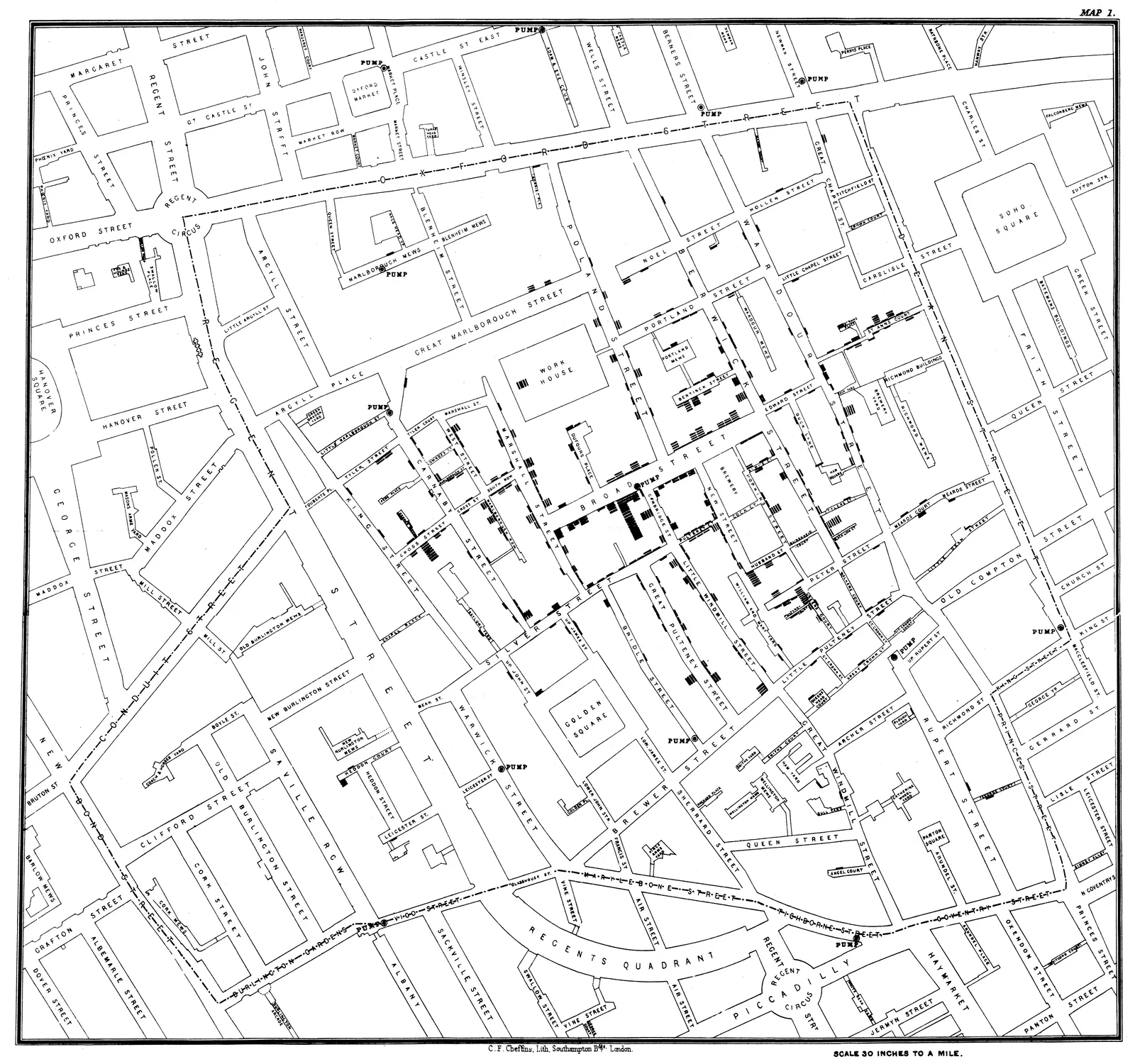
1854 · London. John Snow persuaded the parish board to take the handle off the Broad Street water pump.
The situation
At the end of August 1854 cholera exploded in Soho. Within 250 yards of one street corner, more than 500 people died in ten days. Within six days more than three-quarters of the people in the worst streets had fled. The poor who could not leave stayed with the dying.
Cholera killed fast: violent diarrhoea, dehydration, death sometimes within a day. Nobody knew what caused it. The leading explanation was miasma, foul air rising from filth and rotting matter.
John Snow, 41, was a London doctor best known for anaesthesia. He had given chloroform to Queen Victoria at the birth of Prince Leopold in 1853. He thought miasma was wrong for cholera. The disease attacked the gut, not the lungs, so he suspected people swallowed it, most likely in water fouled by sewage.
The choices
1849 · Publish a theory he could not yet prove
London was in the second year of an epidemic. Snow had a striking case: two facing rows of houses, many sick in one row and one person in the other, where dirty slops ran into a channel that reached a well. It was evidence, not proof, and most doctors believed in miasma.
The safe road was to wait. More cases, more years, then a case no one could dismiss. But people were dying while he waited. The bold road ran the other way: say outright that a living thing caused cholera. That was probably the truth, yet it risked losing every reader who rejected the idea before reaching his evidence.
- Wait for proof. Safer for his name, but cholera would keep killing while he waited.
- Name a living germ. Probably the truth, but it risked losing readers before they reached his evidence.
- Publish now, worded carefully. Puts the idea on record during the epidemic, at his own expense.
Snow took a narrower path between them. In August 1849, during the epidemic, he published a 39-page pamphlet, On the Mode of Communication of Cholera, at his own expense. He wrote of a "poison" that could multiply in the gut and left the word organism out. The pamphlet was one tract among many and had little effect. A September review praised the effort but said other causes "irrespective of the water" might have been at work, and that he had not proved his case. That October, colleagues at his lectures stayed sceptical.
August 1854 · Make the water-company test credible
Five years on, south London offered a better test. In 1852 the Lambeth company had moved its intake up the Thames to Thames Ditton, above the city's sewage. The Southwark and Vauxhall company still drew from the river in London. Their pipes ran down the same streets, so about 300,000 people were split between clean and fouled water "without their choice, and, in most cases, without their knowledge."
The quick way was the official district figures, already published, but the companies were mixed street by street and a district total could not tell them apart. The next quickest was to knock and ask. That failed too. Landlords or agents paid the water rate, and tenants, Snow found, "can seldom remember the name of the Water Company."
- Use the district figures. Quick and already published, but they could not tell the two companies apart.
- Take the answer at the door. Fast, but tenants seldom knew which company supplied them.
- Check every house and test the water. Slow and laborious, but hard for a hostile reader to dismiss.
So from the middle of August Snow went house by house and refused to trust the answer at the door. He asked for the water-rate receipt. Where that failed he used the river itself: Southwark and Vauxhall water, drawn where sea water reached up the Thames, held nearly forty grains of salt per gallon, while Lambeth water held under one. A simple salt test told him whose water came out of a tap when no one in the house knew. He called it "a good deal of trouble" and took on a medical assistant, John Joseph Whiting, to cover more districts. A fortnight in, Soho erupted.
3 September 1854 · The water looks clean
Snow suspected the Broad Street pump at once. On the evening of 3 September he examined its water. It held so little organic impurity that, as he wrote, he hesitated to reach a conclusion. His theory said the pump was poisoned. His eyes said it looked fine.
Here the paths split hard. The obvious reading was clean water, wrong suspect, and look elsewhere. The parish was already on another road. Within days a Times correspondent described the streets "white with chloride of lime", washed every evening. On the miasma view that was exactly right. On Snow's view it attacked the smell and left the source pouring.
- Trust the sample. Clean water, wrong suspect: easy to accept, and it risked dropping the right answer.
- Join the cleaning. Right on the miasma view, but on Snow's it left the source pouring.
- Count the dead. Ask where the dead had drunk, whatever the water looked like.
Snow put the sample aside and counted the dead. He took the list of cholera deaths from the General Register Office, 89 in the week ending 2 September, and went to the addresses. The deaths clustered around the pump. The exceptions sharpened the pattern. The Poland Street workhouse, nearby, had its own well, and only five of its 535 inmates died. More than 70 men at the Broad Street brewery drank its malt liquor, not pump water, and none died of cholera. A widow in Hampstead, who had not been near Broad Street for months, had a bottle of its water carted to her daily. She drank it on 31 August and died on 2 September. Over the next two days he saw white specks in the pump water come and go.
7 September 1854 · Ask for one act, not agreement
On the evening of Thursday 7 September Snow went to the Board of Guardians of St James's parish. The board believed in bad air.
He had his count of the dead and his exceptions. The scholar's move was to write it all up for the journals and let the profession judge, which would take months while the pump stayed open. The fighter's move was to try to convert the board to the water theory on the spot. In our reading that was the path most likely to fail: a parish board was not going to overturn medical opinion in one evening.
- Publish and wait. Lets the profession judge, but takes months while the pump stays open.
- Argue the theory. Would settle the question, but a parish board was unlikely to convert in one evening.
- Ask for one act. Remove the pump handle; the board need not agree with him.
Snow asked for something smaller. He did not need them to agree, only to remove the handle of the Broad Street pump. They did not agree. A colleague later recalled the vestry was "incredulous", and another wrote simply, "He was not believed." But the act cost them little, and the handle came off the next day, 8 September. The risk sat with Snow. If deaths went on, his theory would look worse than before.
1855 · Claim the victory, or tell it straight
Snow expanded his book in 1855 with both studies and his map of the Soho deaths. The tidy story was right there: handle off, outbreak over. It would have persuaded, until someone checked his own figures.
- Claim the victory. Handle off, outbreak over: persuasive, until someone checked his own figures.
- Tell it straight. Honest about the decline already under way, at the cost of a weaker headline.
He told it straight. New attacks had already fallen sharply before the handle came off, he wrote, and it was "impossible to decide" whether the well still held the poison by then. He credited the flight of the population with keeping the toll lower. It was the honest account and a weaker headline, in a fight he was losing.
What it changed
Not much, at first. The General Board of Health's inquiry rejected his explanation, writing that it saw "no reason to adopt this belief". By some accounts the handle went back on once the epidemic passed. Snow died in 1858, aged 45, before his theory was widely accepted.
Henry Whitehead, a local curate, set out to refute Snow and ended up supporting him. He traced the likely start to five-month-old Frances Lewis at 40 Broad Street, whose soiled nappies had been rinsed in water tipped into a cesspool less than three feet from the well. In south London's first seven weeks, houses on Southwark and Vauxhall water had 315 deaths per 10,000 against 37 on Lambeth. London built a vast new sewer system. Its last major cholera epidemic came in 1866, in parts of east London not yet connected, and after it the authorities accepted Snow's ideas. His two studies became founding works of epidemiology.
The road not taken
The biggest fork was 3 September. Snow held a sample of water that looked clean. Every other tool of the day agreed with it: no one could see the poison. Had he trusted the sample, the likeliest outcome is that Broad Street would have been treated like every other outbreak, with lime in the gutters, the pump left open, and the decline credited to cleaning. The water-company study would probably have stood alone, a statistical argument put to a profession that had already dismissed his pamphlet. Counting the dead instead gave him the map, and the map is why the case is remembered.
Legend and record
The story goes that Snow ended the epidemic by removing the pump handle himself. He did not remove it; the parish board ordered it. And the outbreak was already declining, as Snow himself wrote. What removing the handle may have done, Whitehead later argued, was prevent a second outbreak: the baby's father fell ill on the day the handle came off.
Sources
- On the Mode of Communication of Cholera, by John Snow (2nd edition, 1855), Wellcome Collection
- John Snow site, UCLA Department of Epidemiology
- Snow's 1849 pamphlet and its reception (UCLA)
- Investigation of the Broad Street pump outbreak, with Part 2 of Snow's 1855 book (UCLA)
- Removal of the handle, the index case and Rev. Henry Whitehead (UCLA)
- The "Grand Experiment": setting up the south London inquiry (UCLA)
- The "Grand Experiment": Lambeth and Southwark and Vauxhall water companies (UCLA)
- John Snow hunts the blue death (Science History Institute)
- John Snow: cholera and the Broad Street pump (London Museum)
