How the Wright brothers threw out the textbooks and learned to fly
Two Ohio bicycle makers found that the published numbers on wings were wrong. The choices that followed, from a twisting kite in 1899 to a wind tunnel and four flights at Kitty Hawk on 17 December 1903, made them the first to fly a powered, controllable airplane.
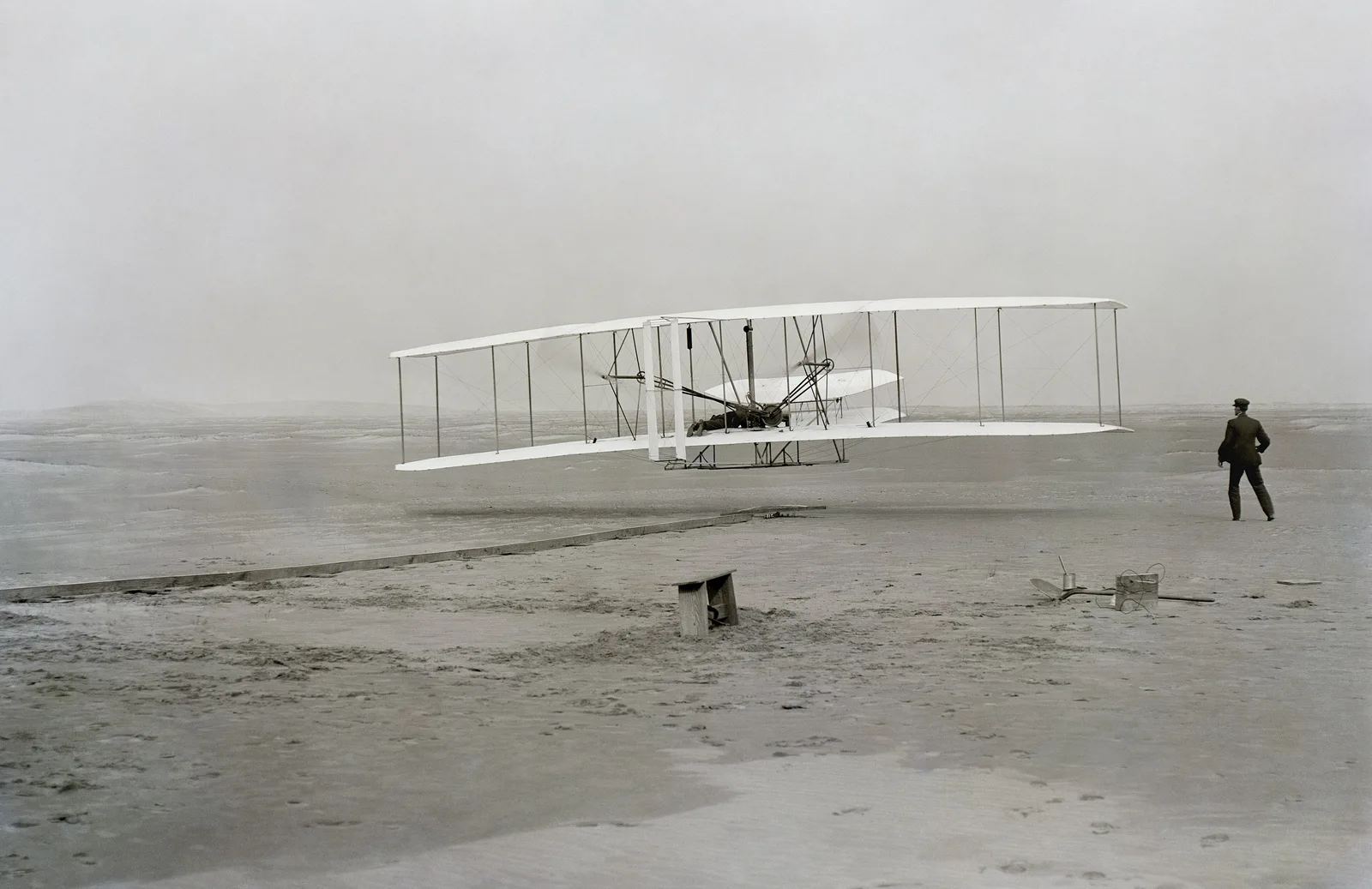
1901 · Dayton, Ohio. After two summers of gliders that lifted a fraction of what the books promised, Wilbur and Orville Wright stopped trusting the published tables and built their own wind tunnel to measure wings.
The situation
In the summer of 1896 news reached Dayton, Ohio, that the German glider pilot Otto Lilienthal had been killed while gliding. Wilbur and Orville Wright, two brothers who ran a bicycle business in the city, had flown kites as boys and never quite lost interest in flight. Lilienthal's death made them start reading.
What they found was a field in trouble. Experimenters split into two camps, as the brothers later described it. One, led by the American scientist Samuel Langley and the inventor Hiram Maxim, put engines on wings and tried to drive them into the air. The other, led by Lilienthal and the Chicago engineer Octave Chanute, built gliders and rode the wind. Maxim spent $100,000 and gave up. Lilienthal and the British glider pilot Percy Pilcher were both killed. By the late 1890s, the Wrights wrote, the public "considered flight beyond the reach of man, and classed its adherents with the inventors of perpetual motion."
The unsolved part was balance. Builders knew how to make wings that lift and engines light enough to drive them. What nobody could do was keep a machine level in gusty air and steer it. "When this one feature has been worked out the age of flying machines will have arrived," Wilbur told a meeting of engineers in 1901, "for all other difficulties are of minor importance."
The choices
1899 · Solve balance first, by twisting the wings
On 30 May 1899 Wilbur wrote to the Smithsonian Institution saying he believed human flight was possible and asking for anything it had published on the subject. The Smithsonian sent pamphlets and pointed him to Chanute's Progress in Flying Machines and the Aeronautical Annuals. The brothers read their way through the field and decided to tackle control before power, on the view that wings and engines were the easier problems.
There were two accepted ways to keep a flying machine level, and the Wrights rejected both. Most designers built in stability: wings set in a shallow V, so that when one side dipped the machine would roll itself upright again. The brothers judged that this kept the machine rocking and worked only in calm air. Lilienthal and Chanute instead balanced by swinging their own bodies, shifting their weight like a hang-glider pilot today. That worked on a small glider, but the brothers reasoned that a pilot's weight could move only so far while gusts grew stronger on bigger wings.
The Wrights knew a machine that was unstable but controllable: the bicycle. They decided a flying machine could work the same way, with the pilot doing the balancing. If the wing on one side met the air at a steeper angle than the other, it would lift more and that side would rise. They thought about gears and pivoting shafts to tilt the wings and found them too heavy. Instead they would twist the whole wing structure, a method they called wing-warping. That summer Wilbur tested the idea on a biplane kite 5 feet across, steering it from the ground with four lines while a group of schoolboys watched. It answered every movement.
- Build in stability. The accepted design, self-righting in calm air and rocking in wind.
- Shift the pilot's weight. Proven on small gliders, and limited by how far a body can move.
- Twist the wings and let the pilot balance. An untried, unstable machine, ridden like a bicycle.
1900 · Go where the wind blows, and practise by the hour
Wilbur worked out that Lilienthal, in five years of gliding, had spent only about five hours in the air, in glides of a few seconds each. Nobody would ride a bicycle through a busy street after that little practice. The brothers wanted hours, not seconds. Their plan was a glider that would hold a man up in a wind of about 18 miles an hour, flown on a rope like a kite, so the pilot could hang in one spot and practise balancing without climbing a hill after every glide.
They could have stayed near Dayton and jumped off hills in whatever wind came. They could have joined the engine camp and built a powered machine straight away. They wrote that they had no patience with "mounting delicate and costly machinery on wings which no one knew how to manage." Instead they wrote to the US Weather Bureau asking where strong, steady winds blew. One promising spot was Kitty Hawk, a fishing village on the sand strip between Albemarle Sound and the Atlantic in North Carolina. William Tate, a local resident, wrote back on 18 August 1900: "If you decide to try your machine here & come I will take pleasure in doing all I can for your convenience & success & pleasure." Polar explorers made the same bet on practice: Roald Amundsen trained himself as a cross-country skier on Norway's Hardangervidda plateau before he tried for the South Pole.
- Glide near home. Cheap and close, with a few seconds in the air at a time.
- Build a powered machine now. The way Langley was going, with nobody yet able to steer it.
- Camp in the windiest place they could find. Weeks away from home and business, for hours of practice.
The 1900 glider disappointed. It needed a wind of about 25 miles an hour to hold a man, and even then only at a steep angle, so the brothers mostly flew it as an unmanned kite, working the controls by cords from the ground. Their hoped-for hours of practice shrank to about two minutes of free gliding. But wing-warping worked, and Wilbur reported it "much more effective than shifting the operator's body."
1901 · Doubt the tables, and build a wind tunnel
For 1901 they built a bigger glider, with 308 square feet of wing against Lilienthal's 151, and curved its wings more deeply to match the shape his tables described. They camped at Kill Devil Hills, four miles south of Kitty Hawk, with two visitors: E. C. Huffaker of Tennessee, who worked for Chanute, and Dr A. G. Spratt, a young researcher from Pennsylvania. Chanute himself spent a week in camp, and William Tate and Dan Tate of Kitty Hawk helped on many days.
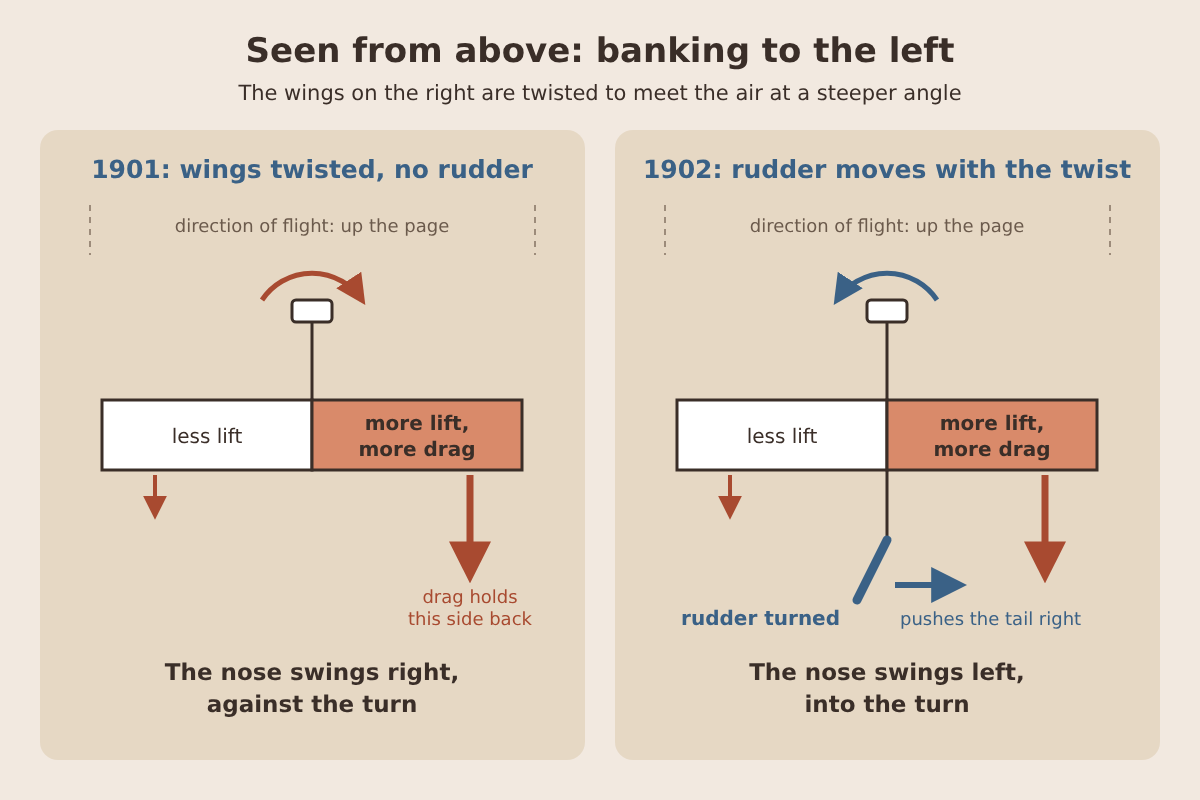
It went badly. The glider produced about a third of the lift the tables predicted. When they twisted the wings to bank, the glider sometimes turned the opposite way, and the wing meant to rise came down instead. Chanute assured them their results were better than anyone's before. The brothers went home discouraged.
They had three obvious options. They could quit, as Maxim had. They could build bigger again, as they had just done. Or they could question the numbers the whole field relied on: Lilienthal's tables of lift for curved wings, and an 18th-century figure for air pressure known as Smeaton's coefficient. "Having set out with absolute faith in the existing scientific data, we were driven to doubt one thing after another," they wrote, "till finally, after two years of experiment, we cast it all aside, and decided to rely entirely upon our own investigations."
First they rigged a bicycle as a test device, which showed their wing needed an angle to the wind more than three times steeper than Lilienthal's figures said. Then, back in Dayton, they built two wind tunnels, a small one and a larger one, and measured small model wings. They tabulated nearly 50 shapes at every angle from 0 to 45 degrees, in steps of two and a half degrees. When one result looked so odd that they almost doubted it, they built a weathervane to test the prediction, and the vane behaved as their tables said. They also arrived at a new value for Smeaton's coefficient, 0.0033 in place of the 0.005 used since the 1700s. "We had taken up aeronautics merely as a sport," they wrote. "We reluctantly entered upon the scientific side of it."
Checking a trusted number instead of building on it runs through later flight history too, as when John Glenn asked for Katherine Johnson to check the computer's numbers for his orbit by hand before he would fly.
- Give up. Two summers spent, and the experts saying flight was a dead end.
- Build bigger again. More wing to make up for missing lift, with the same faulty numbers.
- Measure everything themselves. Months of slow lab work on a hobby, with no promise it would pay.
1902 · Make the rudder move with the wings
Their tunnel data called for wings that were longer, narrower and thinner. They could have gone straight to an engine. Instead they built one more glider, because they could not be sure that numbers from small model wings would hold for a full-size machine. To cure the turning trouble of 1901, they added a fixed vertical tail at the back.
The lift problem was gone: the new glider could hold almost level flight as a kite. The turning problem was not. Sometimes, when the pilot warped the wings, the glider still swung round and plunged into the sand. The brothers called it "well digging." Their own explanation was that the wing twisted to a steeper angle also dragged more, slowed down and lost the lift it had gained. The fixed tail, they found, "increased the trouble, and made the machine absolutely dangerous."
They could have gone back to a glider without a tail, or stiffened the fixed one and hoped. Instead they made the rudder movable and linked it to the wing-warping, so that it turned together with the twist. The turned rudder pushed the tail sideways and swung the nose into the turn instead of away from it.
- Leave off the tail. Back to the 1901 glider's slides.
- Keep the fixed tail. Simpler, and sometimes deadly in a turn.
- Link a movable rudder to the warping. One more control to build, and full command of the turn.
It worked. In September and October 1902 they made nearly 1,000 glides, several longer than 600 feet, some into winds of 36 miles an hour. The Smithsonian's National Air and Space Museum calls the 1902 glider the first fully controllable aircraft: the pilot could control pitch (nose up or down), roll (banking the wings) and yaw (swinging the nose left or right).
1902–1903 · Build the engine and the propellers themselves
Back in Dayton they wrote to motor makers asking for an engine of 8 horsepower weighing no more than 200 pounds. Most were too busy. The one offer looked overrated, so they built their own. Their mechanic, Charlie Taylor, did the machining, and in six weeks a four-cylinder engine was running on the test stand. It gave 16 horsepower for a few seconds, settling to 12, more than they had planned for.
Propellers were harder. They had hoped to borrow the theory of ship propellers, but found marine engineers worked from rules of thumb. So they treated a propeller as a wing moving in a spiral and worked out the design from their own tables. It took months. "After long arguments we often found ourselves in the ludicrous position of each having been converted to the other's side," they wrote. They fitted two propellers turning in opposite directions, so that the twisting force of one cancelled the other's. By their own measurement, the finished propellers turned 66 per cent of the engine's power into useful work, about a third more than Maxim or Langley had managed.
- Buy an engine. Faster, and none on offer was light enough.
- Copy ship propellers. Ready-made rules that nobody fully understood.
- Build and calculate their own. Months of work, and a machine they understood in every part.
17 December 1903 · Fly into a 27-mile wind
Cracked propeller shafts cost them weeks: Orville took them back to Dayton and did not return until 11 December. On 14 December they tossed a coin for the first try. Wilbur won, lifted off from a track laid down the slope of Big Kill Devil Hill, climbed too steeply and stalled into the sand after three and a half seconds. Two days went on repairs.
On the morning of 17 December puddles around the camp were iced over and the wind was blowing 22 to 27 miles an hour. They waited indoors, hoping it would drop. They could have waited for a gentler day, but the weather was getting colder and they had been in camp since September. At ten o'clock they decided to go. They reasoned that the extra danger of flying in a strong wind "would be partly compensated for by the slower speed in landing." They laid the track on level ground and hung out a signal for the men at the Kill Devil Hills Life-Saving Station. John T. Daniels, W. S. Dough and A. D. Etheridge from the station came, along with W. C. Brinkley of Manteo and Johnny Moore, a boy from Nags Head.
At about 10:35 Orville released the wire holding the Flyer to the track. Into the headwind it moved so slowly that Wilbur could run alongside holding the wing. Daniels snapped the shutter of a camera they had set up in advance, catching the machine about two feet off the ground. The flight lasted 12 seconds and ended about 120 feet from where it rose. They flew three more times, taking turns, the last starting at noon. On the fourth flight Wilbur covered 852 feet in 59 seconds. Soon after, a gust flipped the parked machine over and over, with Daniels caught inside it. He came out bruised, and the Flyer never flew again.
- Wait for a calmer day. Easier control, and a season running out.
- Fly into the wind from level ground. A slow launch and a soft landing, in air they had spent three years learning.
What it changed
In 1904 the brothers moved their flying to Huffman Prairie, a field eight miles east of Dayton. Turning was still not fully solved: in tight circles the machine sometimes slid sideways despite the pilot. By the end of September 1905 they had overcome it, and flights grew to several minutes. By 1908 they were flying a two-seat machine to meet a US government contract.
The National Air and Space Museum sums up their legacy as three things: the airplane itself, the methods of aeronautical engineering, including their early use of the wind tunnel, and the habit of flight testing and feeding the results back into the design. Its curators add that the basic design and elements of the Wright machines have been used in every successful airplane since.
Others shared the work. Chanute advised and encouraged them for years. The Tates of Kitty Hawk helped in camp, and men from the life-saving station hauled the Flyer to the hill and witnessed its first flights. Charlie Taylor machined the engine.
The road not taken
The biggest fork came in the autumn of 1901. With a glider that gave a third of its predicted lift, the brothers had every reason to stop, and the field's own record of failure to support them. Had they built a still larger glider on the same tables, it would likely have fallen short again, since the fault lay in the numbers rather than the size. The propellers depended on those same tables too: the brothers designed them as wings from their own measurements.
Someone would likely have flown a controllable airplane within a few years. Langley, with government money, was building a powered machine on the opposite principle, and the Wrights noted he was "still secretly at work". But Langley, as the National Park Service puts it, failed like others before him. The Wrights themselves called their laboratory work the thing "which alone made an early solution of the flying problem possible."
Legend and record
The brothers are often pictured as a pair of handy bicycle mechanics who stumbled onto the airplane. The National Air and Space Museum's account points to their method instead, and the record shows a research programme: a letter to the Smithsonian, a kite, three gliders, two wind tunnels, nearly 50 wing shapes measured, a propeller theory worked out from scratch, and about a thousand practice glides before the engine was fitted. The bicycle trade mattered, but as a source of skills and money, and of the idea that an unstable machine can be balanced by its rider.
Sources
- Orville and Wilbur Wright, "The Wright Brothers' Aeroplane" (1908); Orville Wright, "How We Made the First Flight"; Wilbur Wright, "Some Aeronautical Experiments" (1901). Collected in The Early History of the Airplane, Dayton-Wright Airplane Company, Project Gutenberg eBook 25420
- National Air and Space Museum, "Researching the Wright Way"
- National Air and Space Museum, "The Wright Brothers Made History at Kitty Hawk", 2022
- National Park Service, Wright Brothers National Memorial, "1903 – The First Flight"
- National Air and Space Museum, "The Wright Brothers"
