How Fridtjof Nansen chose to let the Arctic ice carry his ship north
In 1893 the Norwegian explorer Fridtjof Nansen froze his ship Fram into the Arctic pack on purpose. Five choices took his expedition to a record 86° 13.6′ North and brought all thirteen men home: ride the current, build a hull the ice could not grip, leave the ship, turn back, and wait out the winter.
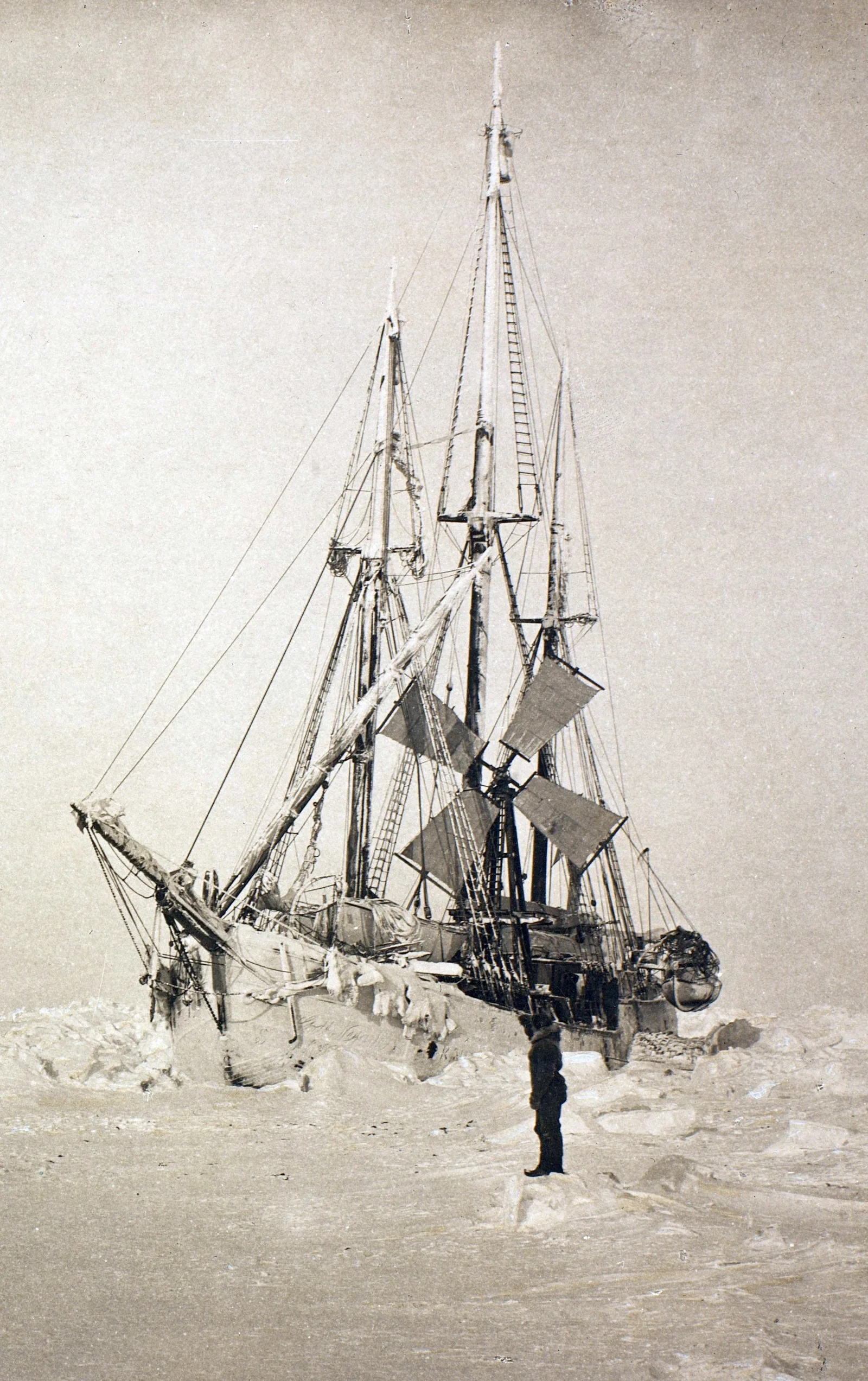
1893 · New Siberian Islands, Arctic Ocean. Fridtjof Nansen let the pack ice freeze his ship Fram in on purpose, betting that the ice itself would carry her across the top of the world.
The situation
In September 1879 the American ship Jeannette, commanded by George W. De Long, entered the pack ice north of the Bering Strait. She stayed locked in it for nearly two years, drifting west toward the New Siberian Islands, until the ice crushed her and she sank on 13 June 1881. Her crew took to the boats and made for Siberia. Most of them, De Long among them, died on the way or in the Lena River delta.
Three years later, pieces of Jeannette turned up on the other side of the world. They were found frozen into drifting ice near Qaqortoq (then Julianehåb) on the south-west coast of Greenland: clothing marked with crew members' names and papers signed by De Long. In 1884 the Norwegian meteorologist Henrik Mohn argued in a lecture that the find meant a current ran from east to west across the whole Arctic Ocean.
A 23-year-old curator at the Bergen Museum read about it with close interest. Fridtjof Nansen had already spent four months on the sealer Viking, three weeks of them trapped in drifting ice. He went on to lead the first crossing of the Greenland ice cap in 1888–89, and when he came home he was ready with a plan for the North Pole.
Most attempts on the Pole had come from the west, through the channels north of Canada and Greenland. Ships were sent to fight their way north against the ice, and the record was one of lost ships and lost men. The best anyone had done was Adolphus Greely's expedition, which reached 83° 24′ North in 1882.
The choices
February 1890 · Ride the current instead of fighting it
Nansen laid out his idea to the Norwegian Geographical Society in Oslo (then Christiania). He listed the failures of the expeditions that had come from the west, then the Jeannette relics and the driftwood from Siberia and Alaska found along the Greenland coast. "Putting all this together," he said, "we are driven to the conclusion that a current flows ... from the Siberian Arctic Sea to the east coast of Greenland." It probably passed across the Pole on the way.
He could have tried the western route again with a better ship and better men, as everyone before him had. He could have waited for firmer proof of the current. Instead he proposed to sail a small, strong ship to roughly where Jeannette went down, push into the ice, and let it freeze around her. The drift would do the work. If the ship sank, the crew would camp on a floe and drift on to safety. Had the Jeannette party stayed on their floe with enough food, he said, "the result would doubtless have been very different".
Most of the experienced polar men thought it was madness. Greely called it "an illogical scheme of self-destruction". Sir Allen Young, who had searched for the lost Franklin expedition, did not believe any ship could survive the squeeze of the pack: "If there is no swell the ice must go through her, whatever material she is made of." Sir Leopold McClintock, just as experienced, called it "the most adventurous programme ever brought under the notice of the Royal Geographical Society". Nansen raised about 445,000 kroner, most of it from the Norwegian parliament and private donors, and went ahead.
- Try the western route again. Familiar, and every attempt so far had failed against the ice.
- Wait for more evidence. Safer, and someone else might take the idea first.
- Freeze in off Siberia and drift. Untested, and the current would carry the ship toward the Pole.
1891–1892 · Build a ship the ice cannot grab
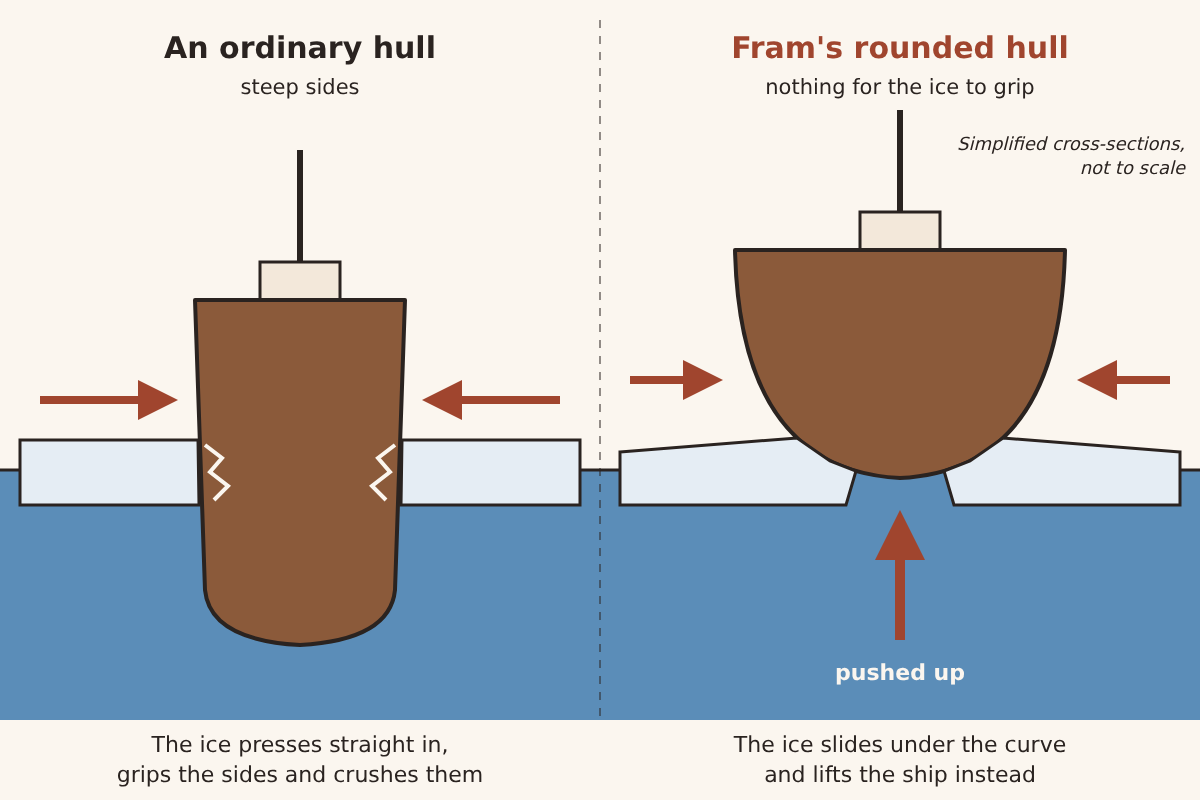
Young's objection was the real danger. When floes are driven together they press on a ship's sides with a force no timber can stop, and the ice had crushed Jeannette. Nansen's answer was to change the shape of the ship rather than only its strength.
He chose Colin Archer, Norway's leading shipbuilder, who was known for seaworthy hulls with a shallow draught. Nansen wrote that Archer made "plan after plan of the projected ship; one model after another was prepared and abandoned". They signed the contract on 9 June 1891. Bow, stern and keel were rounded off and the sides smoothed so that the ice would have nothing to catch on. Pressed from both sides, it would slide underneath and squeeze the ship upward, the way a wet bar of soap shoots out of a closed fist. In Nansen's words she would "slip like an eel out of the embraces of the ice".
Strength still mattered. The hull was built of three layers of wood, including South American greenheart, the hardest timber they could get, between 24 and 28 inches (61 to 71 cm) thick and about 48 inches (1.2 m) at the bow. Beams and braces ran right through her. She came out 128 feet (39 m) long and 36 feet (11 m) wide, a stubby shape that Archer defended: a ship built only for Nansen's purpose "must differ essentially from any known vessel". Speed counted for little next to warm, well-insulated cabins for a drift that could last years. Nansen's wife Eva launched her at Archer's yard in Larvik on 6 October 1892, as Fram, Norwegian for "Forward".
He picked the crew the same way he had picked his Greenland party: few and skilled. Twelve men were chosen from thousands of applicants. Otto Sverdrup, from the Greenland crossing, captained the ship. Sigurd Scott Hansen ran the weather and magnetic observations, Henrik Blessing was doctor and botanist, and Hjalmar Johansen, an army reserve lieutenant and expert dog driver, wanted in so badly that he signed on as stoker, the only post left.
- Strengthen a conventional ship. Cheaper and quicker, and its steep sides give the ice a grip.
- Build a rounded hull for this one job. Slow and stubby at sea, and built to be lifted rather than crushed.
November 1894 · Leave the ship with one companion
Fram left Oslo on 24 June 1893 and took the North-East Passage along the Siberian coast. On 20 September the crew sighted the ice edge just south of 78° North, short of the 80° Nansen had hoped for, and by 5 October the ship was "well and truly moored for the winter", in Scott Hansen's words, at 78° 49′ N. On 9 October the ice pressed in for the first time. She rose and fell, and the ice could not get hold of her. Archer's design worked.
The drift did not behave so well. For weeks the ship wandered in loops, north, then south. Six weeks in, she was south of where she had entered the ice. The 80° line was only crossed on 22 March 1894, and by mid-May she was still making barely a mile a day north. Nansen worked out that at that rate the ship might take five years to reach the Pole.
He could stay aboard and let the ice decide. He could take a large party over the ice, which would mean much more food to haul. He chose to go with one other man, travelling light with dogs. On the way he made a discovery about speed: a man skiing kept pace with dogs pulling a loaded sledge, so the men could ski alongside and the sledges could carry more. On 16 November 1894 he told the crew. When Fram passed 83°, two men would head for the Pole, then for Franz Josef Land, then for Spitsbergen to find a ship home. Three days later he asked Johansen, the best dog driver aboard, to come with him. Sverdrup would take the ship on to the Atlantic.
The crew spent the winter building light sledges on the Inuit model and kayaks for the open water they expected to meet on the way back. Two starts in late February failed when sledges broke. Nansen cut the stores, recalculated the weights, and reduced the train to three sledges. On 14 March 1895, with Fram at 84° 4′ N, they set out with 28 dogs. Nansen allowed 50 days for the 356 nautical miles to the Pole, about 7 a day.
Leaving the ship had a cost. Greely later called it "the single blemish" on the expedition: the commander had left his men hundreds of miles from land.
- Stay with the ship. Safe and comfortable, and perhaps five years with no Pole at the end.
- Take a big party over the ice. More hands, and far more food to haul.
- Go with one companion and the dogs. Fast and light, with no ship to return to.
7 April 1895 · Turn back at 86° 13.6′ North
The first week went better than planned. A sextant reading on 22 March showed 65 nautical miles covered, more than 9 a day, in temperatures around −40 °C. Then the ice broke up into ridges and blocks, and the daily distances fell. On 29 March a sextant and a theodolite gave two different positions, 85° 56′ and 85° 15′, and they had no way of knowing which was right. Worse, the ice under them was drifting south. They were walking north on a floor that carried them back.
By 4 April they put themselves at 86° 3′. Nansen wrote in his diary, "I have become more and more convinced we ought to turn before time." Unless the surface got better, the food would not last to the Pole and then on to Franz Josef Land. After they camped on 7 April he went ahead alone to look for a way through and saw only "a veritable chaos of iceblocks stretching as far as the horizon".
The Pole was still about 226 nautical miles away. They could push on over that ice and hope it improved. They could try to find Fram again, but she was moving with the ice, so wherever they went to look for her would be a guess. Or they could give up the Pole and make for the nearest land, Cape Fligely in Franz Josef Land. Nansen chose the land. Their last camp, at 86° 13.6′ N, was almost three degrees farther north than Greely's record.
It was a hard retreat. On 13 April both men's watches stopped. Without the right time they could not work out their longitude, and if they were farther west than they thought they could miss Franz Josef Land altogether. Nansen restarted the watches on his best guess and they carried on, uncertain of where they were. From late April they killed dogs at intervals to feed the others, and at the start of June seven of the 28 were left.
- Push on for the Pole. About 226 nautical miles of broken ice, on food that might not last.
- **Go back to look for Fram.** A ship drifting with the ice, at no known place.
- Turn for Franz Josef Land. Give up the Pole, and head for land with food on it.
28 August 1895 · Stop and wait out the winter
They saw land for the first time on 23 July. On 6 August they shot the last two dogs, lashed the kayaks together with sledges and skis into a catamaran, raised a sail and crossed to the islands. Nothing they saw matched their rough map. Nansen hoped to reach a hut with supplies at Eira Harbour, at the south end of the islands, built by Benjamin Leigh Smith's expedition in 1881.
Contrary winds and loose ice made every day in the kayaks a risk, and the polar winter was weeks away. On 28 August Nansen decided to stop where they were. In a sheltered cove on what is now Jackson Island, they dug a hole three feet deep, built walls of loose stones round it and roofed it with walrus skins. They called it "The Hole". It was finished on 28 September and was home for eight months. There was plenty of bear, walrus and seal to eat; the worst of it was boredom, and they read Nansen's navigation tables over and over by the light of a blubber lamp.
- Keep going south by kayak. Perhaps a hut and stores, on open water with winter coming.
- Winter where they were. A stone hut and months of waiting, with food all around.
On 19 May 1896 they set off south again. On 17 June, at Cape Flora, Nansen thought he heard a dog bark and went to look. He met Frederick Jackson, an English explorer who had wanted to join Fram, been turned down, and set up his own expedition there. By Jackson's account he asked, "You are Nansen, aren't you?" and got the reply, "Yes, I am Nansen." Jackson's supply ship Windward brought the two men to Vardø on 13 August 1896. Henrik Mohn, whose lecture had started it all, happened to be in the town and greeted them.
What it changed
Fram came through. Under Sverdrup she reached 85° 55′ N on 15 November 1895, only 19 nautical miles short of Nansen's farthest north, and broke out into open water north-west of Spitsbergen on 13 August 1896, close to where Nansen had predicted. Sverdrup brought her into Skjervøy on 20 August, and the next day the whole company met again in Tromsø. All thirteen men came home.
The voyage settled what lay at the top of the world. Soundings of 6,000 to 12,000 feet showed a deep ocean, with no large land between Eurasia and the Pole: land would have blocked the drift. Nansen also noticed that the ice moved to the right of the wind, which he put down to the Earth's rotation; his student Vagn Walfrid Ekman later worked out the theory. The scientific results filled six volumes, and oceanography became the main focus of Nansen's science. His methods, small trained parties, skis and dogs, and gear borrowed from Inuit and Sámi practice, shaped the polar expeditions of the next thirty years. His record stood until 24 April 1900, when a party from the Duke of the Abruzzi's Italian expedition reached 86° 34′ N.
Fram sailed on. Nansen lent her to Roald Amundsen, who took her south, and Johansen went too. On that expedition he warned that it was too early in the season to start for the Pole, and Amundsen's false start in −56 °C proved him right. Ernest Shackleton, whom Huntford counts among Nansen's followers, would one day lose his own ship to the pressure Nansen had designed against, and still get all 28 men of the Endurance home. The ship herself is preserved in the Fram Museum in Oslo.
The road not taken
The biggest fork was on 7 April 1895. If Nansen and Johansen had pushed on toward the Pole, the record suggests what they would probably have met. The ice ahead was the worst they had seen, it was drifting south under them, and Nansen had already judged that the food would not stretch to the Pole and back to land. Even turning when they did, they needed until late July to sight land, with the dogs serving as food along the way and the watches lost. Every extra week north would have meant reaching Franz Josef Land later, with less food, as the summer ice broke up beneath them. They might still have survived. It is more likely the expedition would have lost its two best men.
Sources
- Nansen's Fram expedition, Wikipedia (drawing on Nansen's Farthest North, 1897; Roland Huntford's Nansen; and Fergus Fleming's Ninety Degrees North)
- Fridtjof Nansen, Farthest North, 1897, Project Gutenberg
- Rick Krishfield, "Nansen and the Drift of the Fram (1893–1896)", Beaufort Gyre Exploration Project, Woods Hole Oceanographic Institution
