How Roald Amundsen chose his route to the South Pole and got there first
In 1911 the Norwegian explorer Roald Amundsen beat Scott to the South Pole by five weeks. Six choices made the difference: a secret change of plan, a base on floating ice, a retreat in −56 °C, an unknown glacier, three days of measuring and a steady pace home.
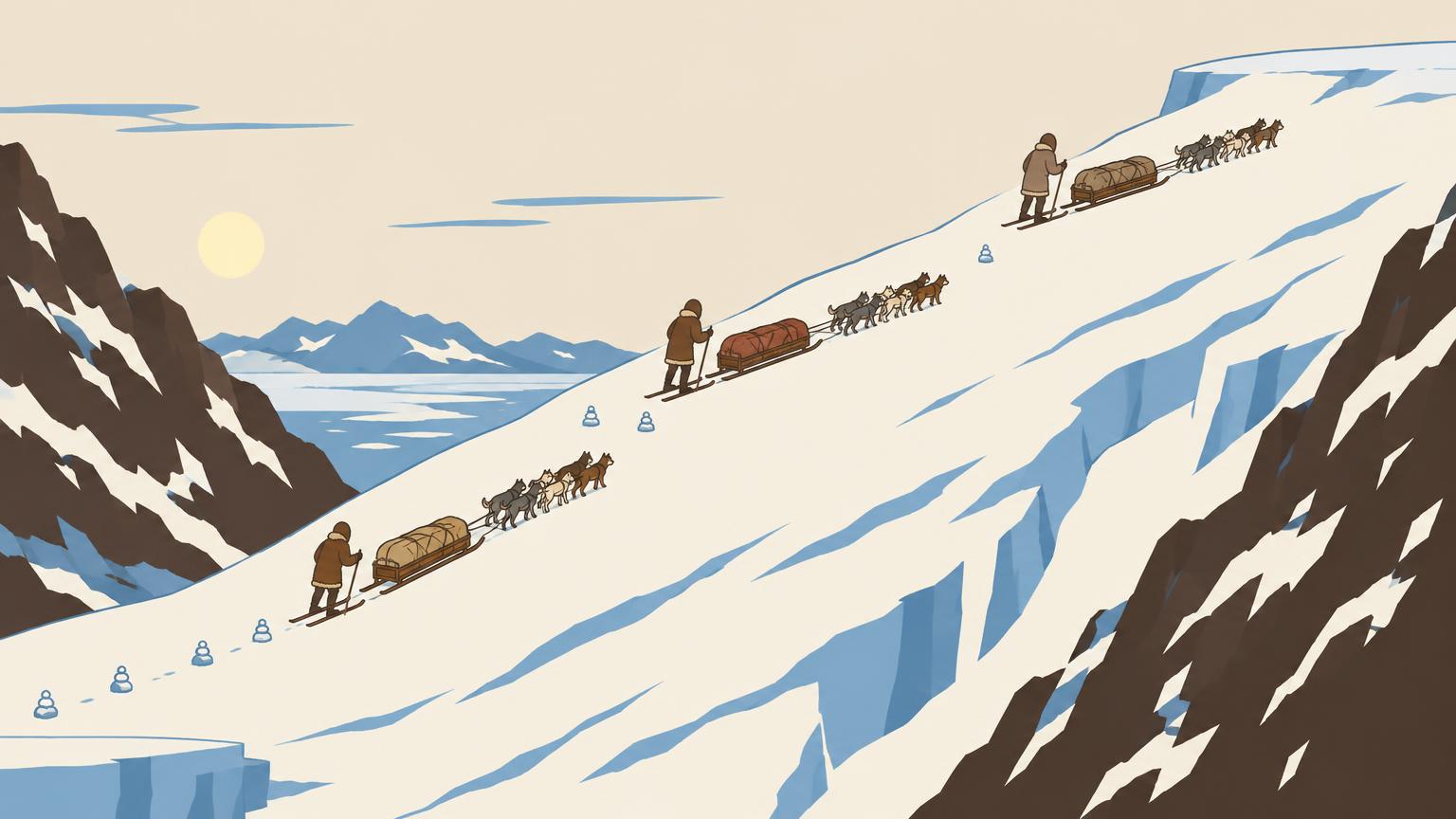
1911 · Ross Ice Shelf, Antarctica. Roald Amundsen based his South Pole attempt on the ice of the Bay of Whales, 60 nautical miles nearer the Pole than Scott, and found his own way up through the mountains.
The situation
In 1909 Roald Amundsen was the man who had sailed the Northwest Passage. He and a crew of six had taken the small sloop Gjøa through the maze of islands north of Canada between 1903 and 1906, a route that had beaten sailors for centuries. His next plan was the North Pole. Fridtjof Nansen had lent him Fram, the round-hulled ship built to be squeezed by sea ice without breaking, and Amundsen meant to freeze her into the pack north of the Bering Strait and drift across the top of the world for four or five years, doing science on the way.
Then, in September 1909, the newspapers reported that two Americans, Frederick Cook and Robert Peary, had each reached the North Pole. Both claims are now widely doubted, but at the time they took the prize away. Amundsen's money had been raised for an Arctic expedition with a pole at the end of it.
The South Pole was still open. Ernest Shackleton had come within 97 nautical miles of it early in 1909 before turning back, and Robert Falcon Scott was preparing a British expedition to finish the job. Scott's ship Terra Nova left Cardiff on 15 June 1910. British expeditions had little faith in sledge dogs; Scott was testing motor sledges. Amundsen had trained himself as a cross-country skier on Norway's Hardangervidda plateau and shared Nansen's view that skis and dogs were by far the best way to travel over snow.
The choices
September 1909 · Turn south, and tell almost no one
Amundsen saw at once what the news meant. Without a pole to win, he later wrote, "If the expedition was to be saved ... there was nothing left for me but to try and solve the last great problem—the South Pole". The Arctic drift could wait a year or two.
He had three ways to play it. He could keep to the Arctic plan, years in the ice chasing a pole the public thought was already won, with interest and money draining away. He could announce a South Pole attempt openly. That was the honest course, but his backers had paid for Arctic science, and Nansen might take back Fram. Or he could go south and say nothing until it was too late to stop him.
He chose silence. For months only his brother Leon, who ran the expedition's business, and his second-in-command, Thorvald Nilsen, knew; the two junior officers, Kristian Prestrud and Hjalmar Gjertsen, were told just before the ship sailed. Most of the crew sailed from Norway in August 1910 still believing they were bound for the Arctic. At Funchal on the island of Madeira, on 9 September 1910, Amundsen told them the truth and asked each man whether he would go on. All of them said yes. He sent Scott a short telegram saying that he was heading south, and wrote a long letter to Nansen asking his forgiveness.
The price was his reputation, for a while. Nansen gave his blessing, but most of the Norwegian press and public condemned the move and the money dried up; Amundsen had already mortgaged his house to keep the expedition afloat. In Britain, Sir Clements Markham wrote of "Amundsen's underhand conduct".
- Keep to the Arctic drift. Years in the ice for a pole others now claimed.
- Announce the South Pole openly. Honest, and backers or Nansen might pull out.
- Go south and reveal it at Madeira. The expedition survives, and trust pays for it.
January 1911 · Build the base on the floating ice of the Bay of Whales
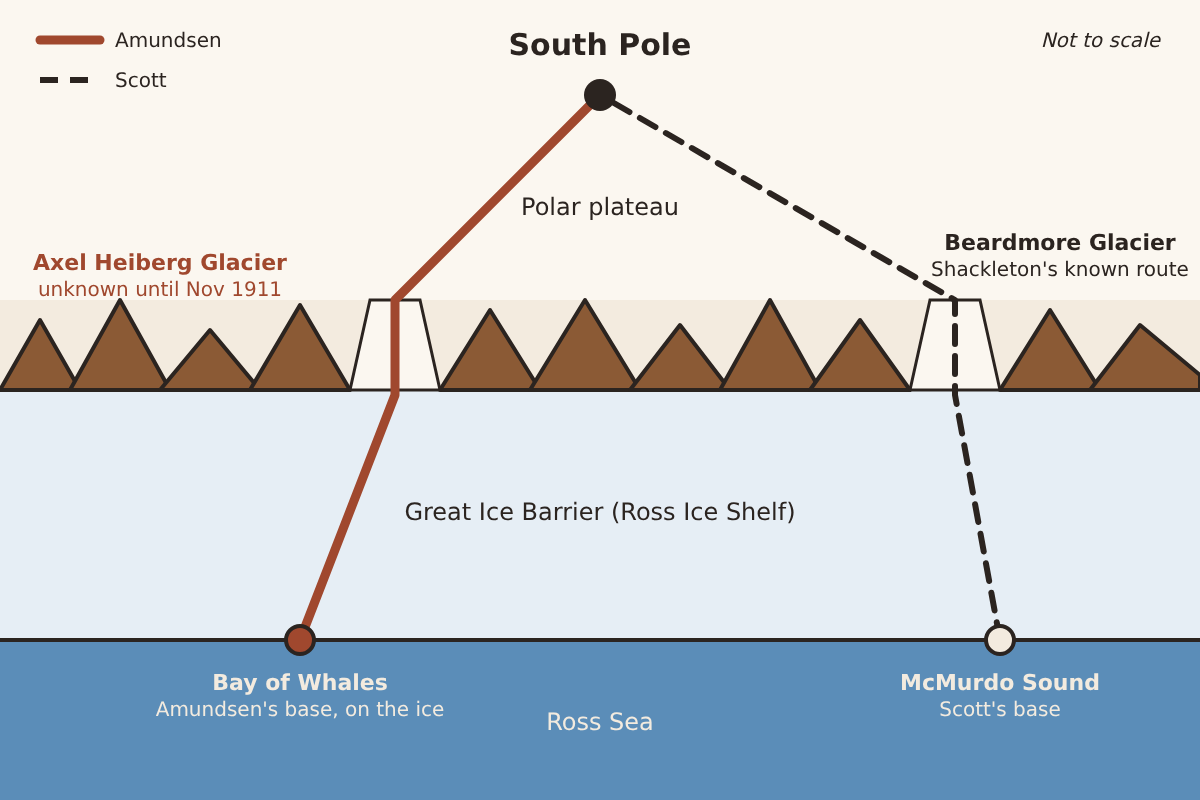
The Ross Ice Shelf, then called the Great Ice Barrier, is a vast sheet of floating ice that fills the southern end of the Ross Sea. Scott was heading for McMurdo Sound, on its western side, where earlier British expeditions had wintered on land.
Amundsen chose the Bay of Whales, an inlet in the Barrier's edge and the farthest south a ship could sail in the Ross Sea. It put his hut 60 nautical miles (about 110 km) closer to the Pole than Scott's. The risk was the ice itself. Shackleton had looked at the bay in 1907–09 and judged its ice unstable. Amundsen studied Shackleton's records and decided the Barrier there must be resting on shoals or rocky islets underneath, and so would hold.
Fram reached the bay on 14 January 1911. The carpenters Jørgen Stubberud and Olav Bjaaland set the foundations deep in the ice and built the hut along an east–west line, with the door facing west, so the prevailing east wind struck only the short end wall. They named it Framheim, "the home of Fram". By the end of January some 200 seals had been brought in for meat.
Amundsen's theory about grounded ice turned out to be wrong. He was lucky in a way he did not know: the ice near his camp did not break away significantly until 1987 and 2000.
- Winter on land at McMurdo Sound. Solid ground and a known route, beside Scott and farther away.
- Winter on the Barrier at the Bay of Whales. Closer by 60 nautical miles, on ice Shackleton distrusted.
12 September 1911 · Turn back from the false start
Before the winter dark, the shore party laid depots of food and fuel at 80°, 81° and 82° South: about 7,500 pounds of supplies, including 3,000 pounds of seal meat. The depot journeys showed that the dogs struggled with heavily loaded sledges, and Amundsen decided to take more dogs on the polar journey, even if that meant fewer men.
Through the winter he worried about Scott's motor sledges, as Sverre Hassel recorded. He wanted to leave as soon as the sun came back in late August. Hjalmar Johansen, who had once marched with Nansen toward the North Pole, warned that it would be too cold on the Barrier so early. Amundsen overruled him. Eight men left on 8 September, when the temperature rose to −27 °C.
Within four days it fell to −56 °C. The dogs' paws were frostbitten, the men could barely sleep, and on 12 September they covered only 4 nautical miles before building igloos for shelter. They could push on and keep whatever lead they had over Scott, in cold that was injuring the dogs. They could wait where they were. Or they could go back to Framheim and lose weeks. Amundsen judged that they had started too early and turned for home. He would not risk men and dogs out of stubbornness.
The retreat was badly handled. On 16 September, 40 nautical miles from the hut, Amundsen raced ahead on Oscar Wisting's sledge with Helmer Hanssen's team. Johansen and Kristian Prestrud came in after midnight with no food or fuel, more than seventeen hours after turning for home. Prestrud's dogs had given out and his heels were badly frostbitten. Several dogs froze to death on the way. The next day Johansen accused Amundsen of abandoning his men. Amundsen dropped him from the polar party and cut it to five: himself, Hanssen, Bjaaland, Hassel and Wisting. Johansen's warning about the cold had been right.
- Push on. Keep the lead over Scott, at −56 °C with frostbitten dogs.
- Wait it out in the igloos. No progress, and no warmth either.
- Go back to Framheim. Lose weeks, and keep men and dogs alive.
November 1911 · Find a new way up through the mountains
This time Amundsen waited for spring. The five men left on 19 October 1911 with four sledges and 52 dogs. They covered more than 15 nautical miles a day and marked the way home with snow-block cairns every three miles. On 17 November they reached the end of the Barrier, where the Transantarctic Mountains stand between the ice shelf and the high plateau around the Pole.
Scott would climb the Beardmore Glacier, the route Shackleton had found. That was well to the west and on Scott's line, not Amundsen's. No one had found a way through the mountains in front of the Norwegians. Amundsen spent several days probing the foothills and climbed to about 1,500 feet before he found a steep glacier, 30 nautical miles long, that seemed to lead straight up to the plateau. He named it the Axel Heiberg Glacier after one of his backers.
It was harder than it looked, with detours and deep soft snow, but in three days of climbing they reached the top. On 21 November the dogs pulled the sledges 17 miles and up 5,000 feet. At the summit, about 10,600 feet up at 85° 36′ South, 45 dogs were left. Only 18 would go on. The rest were killed and their meat shared between men and dogs. "We called the place the Butchers' Shop", Amundsen wrote, and "there was depression and sadness in the air; we had grown so fond of our dogs".
- Head for the Beardmore Glacier. A known way up, far off his line and on Scott's.
- Climb the unknown glacier in front of him. Steep and untried, and straight to the plateau.
14 December 1911 · Fix the Pole beyond argument
They crossed a crevasse field Amundsen called the Devil's Glacier, passed Shackleton's farthest south of 88° 23′ on 8 December, and reached the area of the Pole at about 3 p.m. on 14 December 1911.
The obvious thing to do was plant the flag and start back. Amundsen had watched the arguments over Cook and Peary, though, and wanted proof nobody could pick apart. Finding the Pole meant measuring the height of the sun above the horizon, the same geometry Eratosthenes used with a shadow to measure the whole Earth. They took sextant readings at different times of day, and Bjaaland, Wisting and Hassel skied out in different directions to "box" the spot, so that between them they would surround the exact point. Then they pitched a tent they called Polheim as close to it as their figures allowed and left in it equipment for Scott and a letter for King Haakon of Norway, asking Scott to deliver it.
- Plant the flag and head home. Saves days, and leaves room for doubt.
- Spend three days measuring and boxing the Pole. Costs time, and leaves proof.
18 December 1911 · Go home at a steady pace
Amundsen wanted to be first back with the news. He still kept the daily march to 15 nautical miles to save the strength of men and dogs, and they travelled through the hours that counted as night, in the 24-hour daylight, to keep the sun behind them and lower the risk of snow blindness. Once they reached their first Barrier depot on 7 January, with food all along the trail, they picked up to about 30 nautical miles a day.
- Race for the coast. First with the news, if nothing breaks.
- Hold to 15 nautical miles a day until the depots. Slower at first, and nobody worn out.
What it changed
The five men reached Framheim at 4 a.m. on 25 January 1912, 99 days after they left and 10 fewer than planned, having covered about 1,860 nautical miles. Eleven of the 52 dogs came back. They had reached the Pole five weeks before Scott. Scott and his four companions died on the way back, and Amundsen learned of it about a year later.
The expedition belonged to more than five men. Bjaaland cut the weight of the old sledges by almost a third during the winter by planing down the wood; the cook, Adolf Lindstrøm, kept scurvy away with seal meat, cloudberries, blueberries and wholemeal bread; Prestrud, Johansen and Stubberud made the first exploration of King Edward VII Land; and Nilsen took Fram on a long oceanographic cruise. The research station at the Pole today is named for both Amundsen and Scott.
Shackleton turned next to crossing Antarctica. His ship Endurance was crushed in the ice before he could land, and how he still got all 28 men home is a story of choices of its own.
The road not taken
The biggest fork was on 12 September at −56 °C. Had Amundsen pressed on, the record of the retreat suggests what would probably have followed: several dogs froze to death even on the short journey back, and Prestrud came in with badly frostbitten heels. A party that kept going would likely have lost many more dogs before reaching the mountains, and the whole plan depended on dogs, as food at the Butchers' Shop as well as for pulling. Turning back cost more than a month and kept the expedition intact.
Legend and record
Two details differ between accounts. The date at the Pole is given as both 14 and 15 December, because every line of longitude meets there and so does the date line. Amundsen used 14 December, in his first telegram from Hobart and in his book The South Pole. The telegram he sent Scott from Madeira is also reported two ways: as "Am going south" in some histories, and as "Beg leave to inform you Fram proceeding Antarctica" in others, including Roland Huntford's.
